Thursday, May 4, 2017

Can we know when Jesus will return for...

Monday morning Bible Study, which I typically abbreviate as Monday Morning BS, opened with Matthew 24:42. Ignoring the context and theme of chapter 24, the leader, in typical fashion, spun this to validate the direction he wanted to take and the questions he wanted to ask; in this case - are you ready for His return to catch up the church? And, what bizarre things are your thoughts focused on throughout the day?
Much of the morning was like a stew consisting of conjecture and manipulation, as the leader pushed forward. As he continued to emphasize these horrid questions, he elaborated by asking, how differently would you act if you knew the Lord was coming back in six hours?
Maybe it was confusing situations such as this that motivated Jesus to say,
“for you do not know which day your Lord is coming.”
Since the Jews standing around him had little perception of the Lord's return would mean, I doubt their questions had the same motivation as Jesus'. Since we who have a relationship with Jesus Christ, have a hope in His coming, then we await the day when he comes to gather His church. The problem with this emphasis on waiting is that we, in our religious communities, verbally accost those who express anything that sounds like they are prescribing a time frame.
I happen to think Jesus was very direct with his answers; everything he said was standard terminology and something with which Jesus followers were familiar.
How do I back up a statement like this?
First, let me say that this topic was placed before me by the Holy Spirit just days before. More than just a bit of a coincidence. The topic came in the form of a video excerpt intending to sell a movie about to hit the markets, called, The Coming Convergence. Sorry, I did not pay enough attention to who the speaker was, but the segment took my breath away as he spoke about Matthew 24:36. I give you a piece of that here.
“But of that day and hour no one knows, not even the angels of heaven, nor the Son, but the Father alone.”
The speaker in the video was saying the same things that I have been saying for several years now about how this Bible we read is a Jewish book. Let me give you some additional guidelines to help you understand the Bible: Never lose sight that Jesus was a Jew; that he was speaking to Jews, and that he was talking with standard terms and phrases that would mean something to his audience.
The man in the video explained that the expression we see in Matthew 24:36, “But of that day and hour no one knows, not even the angels of heaven, nor the Son, but the Father alone,” was typical of the day. Jesus' audience would have understood that he was referring to the observance of the New Moon, the indicator of the first day of the month. The express implication, however, applied to the visual sighting of the new moon that would have indicated the New Year – Rosh Hashana, which astronomically will begin at sunset on September 20th.
This observance of the New Moon had to be accomplished by two reliable witnesses and announced to the High Priest at the Sanhedrin. After evaluating the witnesses, the Sanhedrin would then declare the New Month, or the New Year. The thing that makes Jesus statement so valid and yet variable is that weather could obscure the sight of the New Moon. The priests had a contingency for this variability. Since the Jewish calendar worked off of thirty day months, knowing that the moon should have been there, they would, on the next day, decree the new month or year, making that month 31 days.
While I have yet to find a direct reference that associates this phrase “But of that day and hour no one knows, not even the angels of heaven, nor the Son, but the Father alone,” with Rosh Hashana. I simply applied some logic to what I just shared with you, and found it to convey a similar message to what I see in scripture – variability.
The speaker went on to say that in effect, Jesus told the disciples exactly when He would be returning, on the New Moon of the New Year, Rosh Hashana.
Now, please don't stop reading, choosing to respond to the adverse voices in your head. Instead, try applying another piece of logic.
The problem with such a challenging and yet simple subject was that the leader of the Monday morning Bible study had no intention of entertaining challenges from the group. Avoiding questions, although there weren't many, the leader moved rapidly forward through chapter 24 and on into Matthew 25. I am staying focused on Matthew 24:36.
So let's say that you agree with the idea that Christ could return at the Jewish New Year, the 'head' of the year.
  • Even if you are correct and Jesus has the logical arrival time of September 20th of 2017, try sharing that information with most any religious person; you will have an intense fight on your hands, and they will not believe you. I might add that they will use this same phrase, “But of that day and hour no one knows, not even the angels of heaven, nor the Son, but the Father alone,” against you.
  • If you are unlucky, they may merely call you a false teacher as they ignore obvious scriptures which tell us that we are not in the dark, and, that we should not know when that day will come.
Do we have scriptures that tell us that we can have a strong clue as to when Jesus will return?
Yes.
Although Isaiah tends to answer the question in reverse, it will lead me to another scripture, along with the same vein, that speaks more specifically to our knowing when the end will come.
Isaiah 6:9-12 NIrV So he said, "Go and speak to these people. Tell them, "'You will hear but never understand. You will see but never know what you are seeing.' (10) Make the hearts of these people stubborn. Plug up their ears. Close their eyes. Otherwise, they might see with their eyes. They might hear with their ears. They might understand with their hearts. And they might turn to me and be healed." (11) Then I said, "Lord, how long will it be like that?" He answered, "It will last until the cities of Israel are destroyed and no one is living in them. It will last until the houses are deserted. The fields will be completely destroyed. (12) It will last until I have sent everyone far away. The land will be totally deserted.
The context applies to Israel, although it could easily speak to the modern church.
Having been spoken to, by an authoritative source: The Word; prophets; evangelists; pastors, and teachers, why would they not listen?
Jesus was asked by the disciples about why he used parables. I suppose that is because they too did not understand. Look at the interaction in Matthew 13:10-11.
Matthew 13:10-11 NASB And the disciples came and said to Him, "Why do You speak to them in parables?" (11) Jesus answered them, "To you, it has been granted to know the mysteries of the kingdom of heaven, but to them, it has not been granted.
Regardless of whether they understood or not the sentence still stands to this day. “To you, it has been granted to know the mysteries of the kingdom of heaven.”
I just pointed out that Israel was blind to the mysteries, but here in the letter to the church at Colossae, we have Paul telling us that God's mysteries have been manifested to us, His saints.
Colossians 1:25-27 NASB (25) Of this church I was made a minister according to the stewardship from God bestowed on me for your benefit, so that I might fully carry out the preaching of the word of God, (26) that is, the mystery which has been hidden from the past ages and generations, but has now been manifested to His saints, (27) to whom God willed to make known what is the riches of the glory of this mystery among the Gentiles, which is Christ in you, the hope of glory.
I get it. Clearly, there was a time when I might even say. We could not understand. (I could easily debunk that statement because of the Magi. You remember them, foreigners from another nation, who were able to ascertain Christ's arrival, and, explain this information to the elders of the Sanhedrin.) “For to us God revealed them through the Spirit,” now I will give you some grace on this, for the Spirit was not sent until Jesus ascended the last time into the heavenlies. [You should comprehend that we are talking about the Holy Spirit of God, the comforter.]
1 Corinthians 2:9-10 NASB (9) but just as it is written, "THINGS WHICH EYE HAS NOT SEEN AND EAR HAS NOT HEARD, AND which HAVE NOT ENTERED THE HEART OF MAN, ALL THAT GOD HAS PREPARED FOR THOSE WHO LOVE HIM." (10) For to us, God revealed them through the Spirit; for the Spirit searches all things, even the depths of God.
Times and the epochs are certainly an aspect of what we are talking about. Paul writes, “you have no need of anything to be written to you. For you, yourselves know full well that the day of the Lord will come just like a thief in the night.” He is saying what Jesus said, but there is a distinct difference, as he is no longer talking strictly to Jews. Paul and the Holy Spirit know full well that this letter will be spread to all the languages that comprise the body of Christ, and that we too “are not in darkness, that the day would overtake you like a thief.” Jesus, carrying out God's plan, is not sneaking up on anyone, unless they are choosing to remain in the darkness; refusing to accept the truth in God's Word, not mine.
1 Thessalonians 5:1-5 NASB (1) Now as to the times and the epochs, brethren, you have no need of anything to be written to you. (2) For you, yourselves know full well that the day of the Lord will come just like a thief in the night. (3) While they are saying, "Peace and safety!" then destruction will come upon them suddenly like labor pains upon a woman with child, and they will not escape. (4) But you, brethren, are not in darkness, that the day would overtake you like a thief; (5) for you are all sons of light and sons of day. We are not of night nor of darkness;
It would seem that the Apostle John, in conveying the Revelation, understood that we could know the hour Jesus would come; either that, or it is a rhetorical statement and means nothing at all.
Revelation 3:3 NASB 'So remember what you have received and heard; and keep it, and repent. Therefore if you do not wake up, I will come like a thief, and you will not know at what hour I will come to you.
Unfortunately for those that hold this rhetorical point of view, we find that there is nothing in scripture that is unimportant. The Jewish community has held to this idea so much so, that even the spaces between the letters carry great meaning and we see this in the study of Kabbalah. If what John says is true and they who do not wake up will not know the hour, then the inverse must be true and those of us who are awake must be able to ascertain the hour with some certainty.
What then are some of the major clues in scripture?
  • Jesus responded to disciples question with this:
Matthew 24:32-34 KJV Now learn a parable of the fig tree; When his branch is yet tender, and putteth forth leaves, ye know that summer is nigh: (33) So likewise ye, when ye shall see all these things, know that it is near, even at the doors. (34) Verily I say unto you, This generation shall not pass, till all these things be fulfilled.
The fig tree is Israel becoming a nation, and that happened in 1948. What I cannot say with certainty is how many years it takes to define a generation. In an effort to figure out what a generation might be I went to the definitive source – the internet. I am kidding, sort of, and found this, (http://www.bible-codes.org/old-prophecy_5c-Yeshua-codes.htm)
"As the sun was setting, Abram fell into a deep sleep, and a thick and dreadful darkness came over him. Then the Lord said to him, “Know for certain that for four hundred years your descendants will be strangers in a country not their own and that they will be enslaved and mistreated there... In the fourth generation, your descendants will come back here... (Gen 15:16)
God said to Abraham that after 400 years He would deliver Israel, "...in the fourth generation". A generation in the Bible is normally 40 years. However, here a generation is 100 years (4 * 100 = 400 years). This is understood by virtue of the fact that Abraham had his promised child when he was exactly 100 years old (Gen. 21:5); it is evident, therefore, that the age of a man when his first child is born is the raw definition of a generation.
Nevertheless, notice that the full number (400 years) is exactly ten times that of a regular generation of 40 years. Both 100 years and 40 years are a generation in the Bible. However, the average of these two, 70 years, is on occasion also found in the bible, (Psalm 90:10). But "70 years" is a generation according to the average age of a man at his death, rather than when his first child is born (as with the example of Abraham).
40 + 100 = 140 years. 140 ÷ 2 = 70-years as a generation. (Significantly, king David died at age 70 and reigned 40 years.)”
Let's assume then that the average age is seventy. A bit of quick math: 2017 – 1948 = 69 years. Interesting, especially since we right on the verge of a multitude of fascinating, scriptural, and prophetic events, most of which we “Christians” do not have a clue about, but the Jewish community does. Israel, by the way, is, as we speak, celebrating their 69th birthday as a nation.
Continuing with scriptural clues, that tells us if we can know when the end of time is soon upon us.
Luke 21:34-36 KJV And take heed to yourselves, lest at any time your hearts be overcharged with surfeiting, and drunkenness, and cares of this life, and so that day come upon you unawares. (35) For as a snare shall it come on all them that dwell on the face of the whole earth. (36) Watch ye therefore, and pray always, that ye may be accounted worthy to escape all these things that shall come to pass, and to stand before the Son of man.
Key words and phrases in Luke 21:34-36:
  • “take heed to yourselves”
What does that mean? You are responsible for yourselves, no one else.
  • Or, as the Complete Jewish Bible puts it, “your hearts will become dulled.”
Dulled? A dull knife is useless. Try cutting a tomato with one; you might as well be using a rock. The Websters dictionary defines dull as Stupid; doltish; blockish; slow of understanding.
  • Surfeiting - Oppressing the system by excessive eating and drinking;
So it is not just drunkenness that clouds your mind, but an obsession with food can do it as well.
  • And the “cares of this life.”
These take on every shape and form and will create enough anxiety within you to kill you. Since this is an aspect of deception, it is easy to ascertain that it is a weapon of the enemy, Satan.
Although the context of this verse is directed at the Jewish community, as a direct answer to when the Kingdom would be restored, this phrase “And take heed to yourselves, lest at any time your hearts be overcharged with surfeiting, and drunkenness, and cares of this life, and so that day come upon you unawares” can speak to anyone. Sadly, the religious can read this and have one or both of these reactions: I have never tasted alcohol and therefore cannot be included in this paragraph, or, they are blind to the overall context, choosing to ignore it.
Perhaps it is best summed up by the Easy-to-Read Version
Luke 21:34 ERV "Be careful not to spend your time having parties and getting drunk or worrying about this life. If you do that, you won't be able to think straight, and the end might come when you are not ready.
Can you see that life and things will make you unaware through distraction?
Once again, mathematically speaking, there is an inverse to this equation. The obvious answer is that doing your best to steer clear of distractions should put you in a position to be aware of when that day should come.
One of the things I wanted to do was to keep our focus within the New Testament, effectively Paul's letters. I wanted to do that because we as a church want to believe that Paul's writings supersede the Old Testament allowing us to ignore God's word there. That supposition isn't always true because most teachers and preachers will gladly dip back into the OT for the purpose interweaving some guilt and manipulation into their discourse. This type of manipulation comes out deception and distraction from Satan. 
I am not saying the Old Testament is wrong by any stretch – Jesus and Paul both pulled segments from the Law and the Prophets to demonstrate some freedom hidden in it, this is why Paul calls it a mystery. The Law and the Prophets are only a mystery to those who choose not to dig for the treasure buried there.
Jesus, knowing full well that most of the audience was symbolically blind and deaf, spoke to them in parables. He was not trying to confuse them further, he was speaking plainly, openly, and, in language, they should have been familiar with. Much of what he said was directly pulled from the OT. What we see in Mark's gospel is one of those cute parables. (There is nothing cute, hidden, or insignificant about the parables. Most of them are a slap in the face of those who choose to play the Pharisee card.)
Mark 13:28-30 KJV Now learn a parable of the fig tree; When her branch is yet tender, and putteth forth leaves, ye know that summer is near: (29) So ye in like manner, when ye shall see these things come to pass, know that it is nigh, even at the doors. (30) Verily I say unto you, that this generation shall not pass, till all these things be done.
You find this same theme in Matthew 24:35. I feel as though I cannot say this enough; Jesus said these things to his Jewish followers/disciples, as an answer to their question about when He would restore the kingdom and take the throne. This information is not exclusive to Jewish ears and can be easily applied to the modern church age.




Monday, April 17, 2017

What about the hardening of the heart?

The question was posed to our small group, what about the hardening of the heart?
The question is not the problem, and neither is the answer if you think about it; the problem is the heart of the man asking the question because the underlying theme is the lack of understanding about the nature and character of God.
In general, the religious concept of God is that He is merely looking for ways to reduce the population count in heaven by sending people to hell. I say that because I sit with them twice every week, and virtually every time we meet they spin God's word to convey some anger in their hearts, which allows them to send multitudes to hell.
How can I prove that God's desire is for us and that he does not want to send any to hell? Let's start with Matthew 18. Here is the parable in which the shepherd seeks out that one lost sheep. The idea is that they are all valuable and none, it seems, are worthy of ignoring or throwing away. However, the parable goes far beyond that, and we see this in verse 14.
Matthew 18:14 ERV in the same way your Father in heaven does not want any of these little children to be lost.
First – Though readable, the ERV seems to be lacking concern in its translation when you compare it with the NASB.
"So it is not the will of your Father who is in heaven that one of these little ones perish. (Matthew 18:14 NASB)
The NASB seems rather straightforward in saying, “it is not the will of your Father who is in heaven..”. However, there are greater implications. When I look up the words little ones, I find a meaning that takes on a larger scope.
mikros; small, little: - least (4), less (1), little (13), little ones (6), little while (10), short (1), small (8), smaller (2), smallest (1).
It also applies to those who are not on the forefront; insignificant; perhaps those with downs syndrome, or those who just not as aggressive in business and lacking in competitive skills. The Word Study Dictionary implies those not: “Of magnitude (Mat_13:32; Mar_4:31; Jas_3:5); of stature (Luk_19:3; Sept.: Eze_17:6); of age meaning small, young, not grown up (Act_8:10; Act_26:22; Heb_8:11; Rev_11:18; Rev_13:16; Rev_19:5, Rev_19:18; Rev_20:12).”
The same definition applies to the word perish that we see in the NASB, as it does to the word lost in the Easy Read Version.
apollumi and it means to destroy, destroy utterly:
Of the thirty Bibles, I have immediate access to, the word choices are about half/half between lost or perish. To be lost frequently holds out the hope that you will eventually be found, but to perish conveys a permanent condition. Since we should understand that the one aspect of our lives that lives forever is our soul/spirit, then our next logical assumption is that this idea of perishing has little to do with the cessation of breath. To rewrite the sentence using the words of Wilbur Pickering; Wilbur N. Pickering, ThM Ph.D., the one stand out from the crowd, I might say,
“..it is not a desire, in the view of your Father in heaven, that one of these little ones should be wasted.”
What is to be wasted?
It is to be thrown aside while someone or something still had some use? We now see ordinances being enforced which prohibit markets from throwing out food products that could still find some useful benefit, like feeding the homeless. We often see no value in some people and are more than willing to cast them aside.
Again I rewrite the sentence:
So it is not the will of your Father who is in heaven that one of these little ones should be destroyed utterly.
What are we talking about when we say to destroy utterly? Isn't it to be separated eternally, from God and His presence. In Revelation 20 we are told those whose names are not found in the book of life are thrown into the lake of fire. Being tossed into a lake of fire should demonstrate an utter destruction/separation from God.
Revelation 20:15 NASB And if anyone's name was not found written in the book of life, he was thrown into the lake of fire.
And, 1 Corinthians 6 explains in more detail than I wish to give, how that the unrighteous will not inherit the kingdom of God.
1 Corinthians 6:9 NASB Or do you not know that the unrighteous will not inherit the kingdom of God?
So far I have pointed out God's heart, in that I believe He does not wish to lose anyone. If I can give you one more piece of evidence, it would be the old standard, John 3:16, 17.
John 3:16-17 NASB "For God so loved the world, that He gave His only begotten Son, that whoever believes in Him shall not perish, but have eternal life. (17) "For God did not send the Son into the world to judge the world, but that the world might be saved through Him.
You have to be blind to not be able to see that God desires eternal life for all and that he, in contrast to what I hear every week, did not send His Son into the world to judge it, but save it through Him. There are no limitations and restrictions in that statement.
As Bob Dylan use to sing, you might serve the devil, or you may serve the Lord, but you are going to have to serve somebody! Those who by choice serve the devil will follow their master to his appointed, eternal destruction, while those who choose to serve the Lord will follow Him into an eternity of peace and joy.
Now, that being said, what do we do with statements and situations like this?
Exodus 4:19-21 NASB Now the LORD said to Moses in Midian, "Go back to Egypt, for all the men who were seeking your life are dead." (20) So Moses took his wife and his sons and mounted them on a donkey, and returned to the land of Egypt. Moses also took the staff of God in his hand. (21) The LORD said to Moses, "When you go back to Egypt see that you perform before Pharaoh all the wonders which I have put in your power; but I will harden his heart so that he will not let the people go.
Moses murdered an Egyptian; however, we do not see God's judgment upon Moses or any implication that God wipes Moses' name out of the book of life because of his “sin.” (I can explain and validate this, later on, should I choose.) God does, however, tell Moses that those who sought his life for the murder are dead. So, even though Moses is not our focus, he too has the potential to harden his heart. After all, didn't he just spend 40 years in the desert, something that would turn many against God?
“When you go back to Egypt see that you perform before Pharaoh all the wonders which I have put in your power, but I will harden his heart so that he will not let the people go.”
God, it would seem, is going out of His way to get Pharaoh's attention, not merely kill him. We assume, and probably historically so that Pharaoh had a first born son who was killed on the night of Passover, the last draw. And yet, in spite of all this, Pharaoh's heart did not turn to God but was hardened by Pharaoh himself.
Look at the word hardened.
Hardened, is the Hebrew word chāzaq. The Word Study Dictionary tells us that it is a verb meaning to be strong, to strengthen, to be courageous, to overpower. The verb chāzaq is widely used to express the strength of various phenomena, such as: the severity of famine (2Kings 25:3; Jeremiah 52:6); the strength of humans to overpower each other: the condition of Pharaoh's heart (Exodus 7:13); David and Goliath (1Samuel 17:50); Amnon and Tamar (2Samuel 13:14); a battle situation (2Chronicles 8:3).
Pharaoh certainly played the game of dominance with Moses.
Another commentary, the NNIBC, says something comparable to the idea that it is the man that hardens his heart.
“In the following passage, Pharaoh, most likely Amenhotep II (c. 1447-1421 B.C.), is not simply the king of Egypt, but a symbol for all who resist God, for all of God's enemies. I will harden his heart: Some interpret these words as meaning that God would confirm what Pharaoh had stubbornly determined to do. In the first five plagues, the hardening is attributed to Pharaoh (Exo_7:13, Exo_7:22; Exo_8:15, Exo_8:19, Exo_8:32; Exo_9:7). Then for the sixth plague, God hardened a heart that Pharaoh had already hardened (Exo_9:12).” Nelson's New Illustrated Bible Commentary
Do we forget that God also said he would punish Israel for their sins,
Exodus 32:34 NASB "But go now, lead the people where I told you. Behold, My angel shall go before you; nevertheless, in the day when I punish, I will punish them for their sin."
and then went about bringing nations and people against them.
Isaiah 13:4-5 NASB A sound of tumult on the mountains, Like that of many people! A sound of the uproar of kingdoms, Of nations gathered together! The LORD of hosts is mustering the army for battle. (5) They are coming from a far country, From the farthest horizons, The LORD and His instruments of indignation, To destroy the whole land.
Who then is doing the punishing, God or man? The answer is both. Now, is it God that does the hardening of the heart or does He merely allows the man to do his thing, while God, at some point, slams the door shut.
You see, the problem is that God's word and these themes we find are not always so clear cut, are they?

Thursday, April 13, 2017

Commentary and thoughts on Revelation 2:20

The commentaries I have been tossing out here, are the result of my interactions with a mix of men. Some come to Monday morning Bible study, a couple of others I have been introduced to at the various coffee shops we used to sit at.
Call me naive if you wish, but I really am an optimist, believing that other “Christians” would be interested in discussing scripture, or at a minimum, sharing what God has done their lives. One fellow in particular consistently interrupted the flow of conversation with a joke, a story, and a recap of his historical background as a pastor. We, for the longest time, tried to get him to stop with the interruptions, but he would not. The result, I left the group for about six months. (Sometimes you have to get your brain back.) When I was invited back to the group, I found that the trouble maker had taken my admonitions perhaps too seriously, because he appointed himself as the table pastor, thinking he has the authority to control our interactions in the public venues we sit at.
If you have the audacity to assume the position of leader, then you have a responsibility to keep your opinion, which is loaded with conjecture, to a minimum. A second aspect is that you should stick closely to God's word.
Here is a tip: The Word of God is almost self-explanatory; this is especially true when you do your homework, think like a Jew, and look for the patterns that initiate within the Old Testament.
Our little group, because the “leader” decided he wanted to, has taken us into the Churches of Revelation. That wouldn't be a problem if we hadn't just spent almost two years unsuccessfully hashing our way through the Revelation. Never-the-less, these forays always seem to give me fuel to work with. Jezebel is one of those, and we find her in Revelation 2:20.
Revelation 2:20 NIrV "But here is what I have against you. You put up with that woman Jezebel. She calls herself a prophet. With her teaching, she has led my servants into sexual sin. She has tricked them into eating food offered to statues of gods.
,(Look this up in 1Kings 21:7-17).
I will initiate the response with a bit of context. Ahab wanted the vineyard of Naboth, but the man would not sell, and this primed Ahab for his depression. Now read about his interaction with this deadly wife of his.
1 Kings 21:6 NIrV He answered her, "Because I spoke to Naboth from Jezreel. I said, 'Sell me your vineyard. Or, if you prefer, I'll give you another vineyard in its place.' But he said, 'I won't sell you my vineyard.'"
After hearing what her husband had to say, she responds with:
1Kings 21:7-17 NIrV His wife Jezebel said,
"Is this how the king of Israel acts?
Get up!
Eat something! Cheer up.
I'll get you the vineyard of Naboth from Jezreel."
(8) So she wrote some letters in Ahab's name. She stamped them with his seal. Then she sent them to the elders and nobles who lived in the city where Naboth lived. (9) In those letters she wrote, "Announce a day when people are supposed to go without eating. Have Naboth sit in an important place among the people. (10) But put two worthless and evil men in seats across from him. Have them witness to the fact that he has called down curses on God and the king. Then take him out of the city. Kill him by throwing stones at him." (11) So the elders and nobles who lived in that city did what Jezebel wanted. They did everything she directed in the letters she had written to them. (12) They announced a day of fasting. They had Naboth sit in an important place among the people. (13) Then two worthless and evil men came and sat across from him. They brought charges against Naboth in front of the people. The two men said, "Naboth has called down curses on God and the king." So they took him outside the city. They killed him by throwing stones at him. (14) Then they sent a message to Jezebel. They said, "Naboth is dead. We killed him by throwing stones at him." (15) Jezebel heard that Naboth had been killed. As soon as she heard it, she said to Ahab, "Get up. Take over the vineyard of Naboth from Jezreel. It's the one he wouldn't sell to you. He isn't alive anymore. He's dead." (16) Ahab heard that Naboth was dead. So he got up. He went down to take over Naboth's vineyard. (17) Then a message from the LORD came to Elijah, who was from Tishbe. It said,
I have a Question, and it's a huge one, what is Jezebel: is she representative of the historical person, a spirit, or the real thing?
  • It would not be logical to assume that this is the Jezebel that I showed you from 1Kings since Jezebel is long since dead.
  • It is also possible that there is a demon/fallen angel that carries the name Jezebel and has possessed this woman. Since spirit beings live forever then this thing that is controlling her could well be alive today in someone else. Jesus explained all this when he told the group following him, that when a demon is cast out, it seeks someplace to make its abode. Not finding a place it will attempt to return to its last home. Take the time to look this up for yourselves. You will find it in Matthew 12:43-45. (We too are spirit beings clothed in human bodies, and will, therefore, continue to exist/live forever with the person we choose to follow, whether it be Satan or Jehovah.)
  • Our third option is that this person is representative of things that Jezebel stood for (which was nothing good.)
What do we know about the historical Jezebel?
2 Kings 9:30 NIrV Jehu went to Jezreel. Jezebel heard about it. So she put makeup on her eyes and fixed her hair. She looked out of a window.
She had ordered Naboth to be killed. She did this through deceit, attributing her actions to her husband, and distributing the guilt among many. I suppose the alternate motive here would be an attempt to remove guilt from yourself. Does this sound more familiar if I include the name Benghazi? It should as Hillary Clinton, the then, Secretary of State, knowingly sacrificed good men so that she and our president's sins would not be found out and tied back to her.
2 Kings 9:22 NIrV When Joram saw Jehu he asked, "Have you come here in peace, Jehu?" "Your mother Jezebel worships statues of gods," Jehu replied. "She also worships evil powers. The evil things she does have spread everywhere. As long as all of that goes on, how can there be peace?"
  • Jezebel worships statues of gods,
  • She worships evil powers.
  • The evil things she does have spread everywhere.
Look once again at Revelation 2:20 where it says, “But I have this against you, that you tolerate the woman, Jezebel,”
Tolerate? We tolerate uncomfortable shoes because we think they make us look better. Paul, in his letter to the Corinthian church, addressed a group of people who tolerated some open perversion within their body of believers.
1 Corinthians 5:2 NIrV And you are proud! Shouldn't you be filled with sadness instead? Shouldn't you have put the man who did that out of your church?
The obvious answer to Paul's question is, YES, they should have, and why? Because cancers, left to grow, will kill the body.
In continuing to find the nature, character, and identity of this "Jezebel," I continue.
1 Kings 18:19 NIrV "Now send for people from all over Israel. Tell them to meet me on Mount Carmel. And bring the 450 prophets of the god Baal. Also, bring the 400 prophets of the goddess Asherah. All of them eat at Jezebel's table."
We do not immediately perceive from Revelation 2:20 that "she" had a deep influence upon the church in Thyatira, but what we do understand is very blatant:
  • She has led my servants into sexual sin.
Since the marriage bed is blessed by God, there would be no sexual sin, unless you brought in outside perversion.
  • She teaches.
This implies teaching people within the church body, that it is okay to indulge in perversity - thinking that it played some role in worship. Ah, but of what?
  • And she has tricked them into eating food offered to statues of gods.
Let's create a scenario. Having been invited to a home, with the legitimate purpose of espousing the gospel more clearly. Dinner is served, whatever that looks like. You eat it and enjoy.
Having been to Tijuana Mexico on a "missionary" trip, we were escorted in Mexico by two pastors from the area. That evening they took us to a house with no doors and windows where we had the best tacos I can remember. I never asked what kind of meat they put in the tacos, or what the sanitary conditions were because I did not want to ruin the meal I was enjoying. And besides, the pastors were wholeheartedly eating their tacos.
Now back to this home we have been invited to. You might make a statement like, “this is delicious, how was it prepared so that I might make it also?” In many cases, you can go into a home where you are immediately confronted by Buddha statues, or the Indian god of war, Kali. I go to a Chinese, fast food restaurants and there is almost always a small cat-like god by the cash register and fruit is sitting there clearly offered up to this thing. The point being that the indulgences of others are not always so obvious. Having asked your host the question, they tell you that they are Muslims, and all their meats are Halal, offered up to Allah. (Take the time to look up what makes food Halal.)
Now, aware that you are eating meat specifically offered to some fallen demon angel named Allah, are you knowingly worshiping Allah in your participation? I presented this hypothetical question (Costco sells Halal certified meat in the deli department) to the men I sit with, just to hear what they would say. While some struggled with making a decision, another came back immediately with, I would eat and not feel guilty about any of it. He added, Paul gave us the freedom because all things are legal for us. I tossed in my thoughts, saying, I refuse to buy meats sacrificed to Allah, if for no other reason than to not support what they potentially do with that money.
Not everything is so black and white, is it?

Thursday, April 6, 2017

A short commentary on Revelation 6:4

And another, a red horse, went out; and to him who sat on it, it was granted to take peace from the earth, and that men would slay one another; and a great sword was given to him. (Revelation 6:4 NASB)
Compare the NASB with Complete Jewish Bible translation:
Revelation 6:4 CJB Another horse went out, a red one; and its rider was given the power to take peace away from the earth and make people slaughter each other. He was given a great sword.
One claims it was granted to this rider to take peace from the earth and that men would slay each other with the sword. The other, "its rider was given the power to take peace away from the earth and make people slaughter each other."
They are both correct. Being given the power to take away peace does not mean that you do. However, both translations convey violent and bloody imagery. One correctly describes making people slaughter each other with the sword. If, as I have stated on many occasions, this is Islam their primary weapons of death seem to be the sword and bombs. These weapons are not only directed at those they deem infidels but each other as well - this killing of each other is Biblical and can be found in reference to the descendants of Ishmael.
If, as I have stated on many occasions, this is Islam, their primary weapons of death seem to be the sword and bombs. These weapons are not only directed at those they deem infidels but each other as well - this killing of each other is Biblical and can be found in reference to the descendants of Ishmael.
Genesis 16:12 AMP And he [Ishmael] will be as a wild ass among men; his hand will be against every man and every man's hand against him, and he will live to the east and on the borders of all his kinsmen.
Let's assume for a moment that you don't understand what this verse is telling you. I will attempt an explanation.
Any decent Middle Easterner will claim his heritage back to Abraham, and that would be correct. They mistakenly, however, claim Abraham's blessings as well, as that was promised to the child born from the pledge God made concerning Sarah. Since Ishmael was born out of something other than God's direction, there is no blessing given to Ishmael like the one granted to Issac, except for the quantity of descendants. As you can see above, God is not all that worried about your sensitivity to words and references, telling you like it is.
The other aspect of Genesis 16:12, is the fact that they will always scrap with each other.
This might surprise you, but this scenario about their inability to work with each other was also conveyed in Daniel's interpretation of Nebuchadnezzar's statue dream. When Daniel gets to the feet, he calls them mixed, a mixture of iron and clay.
Daniel 2:40-44 NASB "Then there will be a fourth kingdom as strong as iron; inasmuch as iron crushes and shatters all things, so, like iron that breaks in pieces, it will crush and break all these in pieces. (41) "In that, you saw the feet and toes, partly of potter's clay and partly of iron, it will be a divided kingdom; but it will have in it the toughness of iron, inasmuch as you saw the iron mixed with common clay. (42) "As the toes of the feet were partly of iron and partly of pottery, so some of the kingdom will be strong, and part of it will be brittle. (43) "And in that, you saw the iron mixed with common clay, they will combine with one another in the seed of men; but they will not adhere to one another, even as iron does not combine with pottery. (44) "In the days of those kings the God of heaven will set up a kingdom which will never be destroyed, and that kingdom will not be left for another people; it will crush and put an end to all these kingdoms, but it will itself endure forever.
The word mixed is: 'arab: An Aramaic verb meaning to mix, to mingle, to join together.
Do you seriously think this is a coincidence?
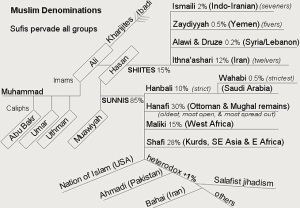
Sects within Islam
Within Islam there are many sects; the two major factions are, Sunni and Shia, and yet one, the Wahabis' of Saudi Arabia, hold most aggressively to the tenets of Islam. How do the various sects handle this internal struggle? They try to kill each other. So, what Daniel explained, "his hand will be against every man and every man's hand against him," is very true.
Take note of some other aspects of the verses from Daniel 2:40-44. The kingdom that is associated with the legs of the statue, and, then integrates into the toes, is made of iron; very strong, yet brittle. An obvious factor is that iron combined with clay is useless, and yet, that is the overall effectiveness of this undefined kingdom; but is it undefined?.
I can tell you that it feels like peace has been removed from the earth, and yet, this is nothing compared to what is coming. How fast all this will happen can only be experienced. I believe that much of this killing will be carried out by Islam, but considering the shift we have seen in the United States, it looks like the government will gladly be killing us off.
How fast will all this happen can only be experienced first hand. I believe that much of this killing will be carried out by representatives of Islam, but considering the shift we have seen in the United States, it looks like our government will gladly be killing us off.
If we were to be given a choice by God as to how we get to die, I believe I would choose a quick and relatively painless death. Seeing as that does not play into the equation of our lives, then we take what we get.

Featured Post

Will we have to go through the tribulation?

"Then I heard a loud voice from the temple, saying to the seven angels, "Go and pour out on the earth the seven bowls of the wrath...