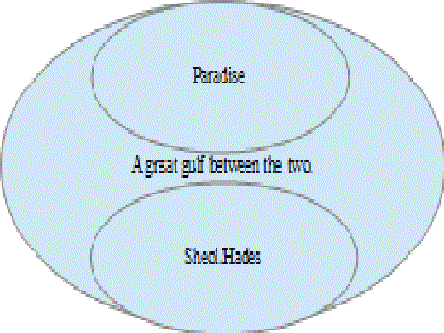
When it comes to heaven, our primary source of information comes from the book of Revelation. Yet, by consensus, Revelation is one of the most perplexing books of the Bible, outside of, say, Leviticus and Numbers.
If you want to understand a concept like death, a book like the Revelation, or a construct like Heaven, you should search for corroborating evidence and attestations from the Bible and consider the context.
One other piece of information, which applies to the idea of Heaven that I am going to dive into momentarily, is that this Bible and the book of Revelation, where many of the references to Heaven make their home, is to understand that the Revelation is a Jewish-centric book.
Evidence for this assertion comes from Revelation 1:2, where we immediately encounter the proclamation that all of this is "the testimony of Jesus Christ.” This pronouncement should make us concentrate on the fact that the book of Revelation is focused on a Jewish man, God's Son, and the journey He is taking us on.
The second thing that plays a role in how you read and understand the Revelation is that John, for the longest time, focused his attention on the Jewish believers. In other words, John’s primary audience was Jewish believers.
Saul/Paul was in hearty agreement with putting the believers to death. And on that day, a great persecution began against the church in Jerusalem, and they were all scattered throughout the regions of Judea and Samaria, except the apostles. (Acts 8:1 NASB)
Their staying in Jerusalem was not fearlessness but a dedication to the Jewish community who accepted Jesus Christ as the Messiah. John maintained a strong Jewish connection and motivation. However, he assumed the reins of one of Paul's established churches with a large congregation of Gentile believers alongside the Jewish followers.
Thirdly, look at the terminology that John uses in Revelation 2:8,9.
"And to the angel of the church in Smyrna write: The first and the last, who was dead, and has come to life, says this: 'I know your tribulation and your poverty (but you are rich), and the blasphemy by those who say they are Jews and are not, but are a synagogue of Satan." (Revelation 2:8-9 NASB)
Why say something like this unless there are Jewish believers there? Gentiles did not go to the synagogue; Jews did, and it would be foolish to use terminology that would make no sense to the Gentiles.
These same concepts apply to the entirety of the Bible, and you see strong evidence for that in Paul's letter to the church in Rome. You also see comparable evidence in the letter to Hebrews – Jewish believers. So, if your Gentile mind is struggling, it will be better for you if you can see it through the eyes of a Jew. (That may sound impossible for some, but you may have to trust the Holy Spirit if you get stuck.)
The motivation for writing about Heaven initiated with the study I have been doing on the Revelation chapters 20-22. These chapters focus on the end of judgment and the new heaven and a new earth. I share these studies with the guys, and they always have questions. Heaven was one of those questions.
One of the men asked about death and Heaven, which prompted him to buy a copy of the book Heaven by Randy Alcorn. I have a copy of that book, but I have little interest in opening it. The first chapter I read started on page twenty-three. By the time I got to chapter five, page 41, I had run into this statement by Randy Alcorn.
“When a Christian dies, he enters into what is referred to in theology as the intermediate state, a transitional period between our present lives on earth and our future resurrection to life on the New Earth.”
The Oxford Languages Dictionary tells us that "theology is the study of God and religious belief." While Wikipedia conveys the idea that it is “the systematic study of the nature of the divine and, more broadly, of religious belief.”
So, for someone to say it is referred to in theology, they might as well be telling me that it is the opinion of others; this is effectively what Randy Alcorn conveys to me when he starts talking about a transitional period. I refuse to accept your opinion as something more reasonable than an understanding of the word of God. What matters is what God has to say about it. If your opinion enhances my understanding, great, but you had better come up with scriptural witnesses to back up your opinion.
I have read through the entire Bible and have done much studying. Not once did I find the terms transitional or intermediate. I have at least 30 translations of the Bible, and some border on being woke, yet none of them used those terms. So again, I am stuck with the idea that this "transitional or intermediate period" is something that religious folk did with their spare time as they looked for ways to make the Bible more complicated. Now, I can see things that I might interpret as transitional or intermediate, but since scripture does not make a doctrine out of vague allusions, neither am I.
Oh, doctrine, by the way, is “anything taught.” Just because I teach, it does not make it right or Godly. When doing Bible study, a couple of rules are context and applicable scriptural witnesses. So these two terms by Alcorn lean toward strikes one and two in my book.
Alright then, let's examine this part of Randy Alcorn's statement.
“a transitional period between our present lives on earth and our future resurrection to life on the New Earth.”
Just the fact that I am standing here on earth, as a Christian awaiting the call to go home, indicates that I am in transition (I am thinking of my permanent home in heaven, which is with the Father. The details are of minor importance because I will own nothing and be happy about it. I no longer have to fear anything because I will be immortal, untouchable, and, as I said, with the Father.) The problem is, most of us do not seem to know that.
But that does not seem to be what Randy Alcorn is saying. Instead, he implies that we go to some transitional place when we die.
Why would you write something that conflicts with the Apostle Paul’s assertion that our separation, as followers of Christ, from this physical body puts us in the presence of the Lord?
"Therefore, being always of good courage, and knowing that while we are at home in the body, we are absent from the Lord--for we walk by faith, not by sight--we are of good courage, I say, and prefer rather to be absent from the body and to be at home with the Lord." (2 Corinthians 5:6-8 NASB)
I get it; Paul’s statement is written in reverse, as Paul acknowledges “that while we are at home in the body, we are absent from the Lord.” But it is not that difficult to comprehend the inverse, that for the believer, we are instantly in the presence of the Lord at death.
A quick definition. Death is a complete and total separation from His presence. It is not God who has done this; it is you by your rejection of Jesus Christ.
Let's talk about resurrection for a moment.
In the Revelation, we are told the martyred saints are raised from the dead – in other words, their bodies are reattached to their spirits. I do not know why. You see this first resurrection in Revelation 20, verses 4 and 5.
"Then I saw thrones, and they sat on them, and judgment was given to them. And I saw the souls of those who had been beheaded because of their testimony of Jesus and because of the word of God, and those who had not worshiped the beast or his image, and had not received the mark on their forehead and on their hand; and they came to life and reigned with Christ for a thousand years. The rest of the dead did not come to life until the thousand years were completed. This is the first resurrection." (Revelation 20:4-5 NASB)
These martyred saints reigned with Christ for a thousand years. I suspect that means they rule over the earth with Him. Ah, but what of the believers? I don't know. I know that we are in Christ, but what that means exactly is not spelled out for us.
Randy Alcorn said we are in "a transitional period between our present lives on earth and our future resurrection to life on the New Earth.”
Surely that means that we are next on the list to be resurrected, right?
We already lost out on the first resurrection opportunity, so maybe we will be next. Wait a minute; Revelation 20:5 tells me that the rest of the dead get resurrected at the end of the thousand years.
Dead? It is unmistakable that we who are in Christ never die.
As I was sitting with my friends, talking about Revelation 20, I was asked, " When do we die, and where do we go?
The answer was, we don't. The Word of God never deems us to be dead (for those who love to argue, the scripture tells us that we were dead in our sins. But having accepted our redemption through Christ, we do not live enslaved to sin anymore, do we.)
Revelation 20:12,13 tells us that the dead are resurrected and brought before the great white throne at the end of the thousand years. They are raised to life again for the sole purpose of standing before that throne. Matthew's gospel in chapter 25 tells us that the nations are brought before the same throne, and it makes no mention of whether these people were dead or not.
Why do you suppose that is?
Because the soul never dies, and they are being identified by that soul and its actions. So, the second resurrection, the last resurrection, has nothing to do with believers who, according to Randy Alcorn, are in a transitional phase when we die.
I am not very familiar with other religions, but one of the Cults believes wholeheartedly that their works may earn them a resurrection to a planet of their own. This bizarre familiarity naturally raises serious concerns about Mr. Alcorn's teachings and even more serious concerns about those pastors who rave about Randy Alcorn's book, Heaven.
I asked the question, at what point does this tired body release its hold on the spirit?
When we physically die or depart with the catching away of the church.
I have no idea or care about the body's importance in this transition, as mine is old, fat, and hurts everywhere. I do, however, know that Jesus had Thomas touch His scars to prove that He was real, and Jesus sat on the beach and ate fish with the guys. Apparently, it takes a body to do those things. Death for those who are not believers is quite the opposite.
"For the living know that they shall die; but the dead do not know anything, nor do they have any more a reward; for their memory is forgotten." (Ecclesiastes 9:5 MKJV)
Let's say you are proficient with the scriptures and can easily see a context to this verse that leans toward understanding your fate. You might be right; however, if you were to look up the Hebrew for the words know and anything, you would realize that it refers to those whose fate is death without apparent hope.
To know is the Hebrew word yâda' and carries the meanings of perceiving, see, distinguish, recognize, and consider. In other words, in this example, the dead did none of the above.
The Hebrew word for anything is me'ûmâh. It also means a speck or anything at all. So, neither do the dead consider, but once they are dead, they think of nothing.
Since Ecclesiastes is marginal as a witness, I suppose you need another to hopefully convince you about this dead "know" nothing stuff.
"Do not trust in princes, In mortal man, in whom there is no salvation. His spirit departs, he returns to the earth; In that very day his thoughts perish."
(Psalms 146:3-4 NASB)
First off, the psalmist talks about mortal man "in whom is NO salvation." This is not a judgment call; it is simply an observation. While the believer returns to the Father, the mortal man returns to the dust, where his very thoughts perish, on that day. Again, the critic might say, of course, in time, we forget about that person unless they made some decisions that we live by. But a statement like this shows that you missed the fact that their thoughts perish, not yours. Like I pointed out with the example from Ecclesiastes, the thought process ceases.
Consider this: if you are transitioning, do you know where to?
Dear Lord, I hope so; this is one of the reasons that we learn that Jesus died on a cross for our sins. I believe in that sacrifice that gives me eternal hope in heaven and a life with the Father.
“These things I have written to you who believe in the name of the Son of God, so that you may know that you have eternal life.” (1 John 5:13 NASB)
On page 42 of his book Heaven, Randy Alcorn says,
“usually when we refer to heaven we mean the place that Christians go when they die. This is what I am calling the present or intermediate Heaven.”
Paragraph two, according to Randy Alcorn, says,
"by definition, an intermediate state or location is temporary. But,… still, the intermediate or present Heaven is not the place we are made for – the place God promises to refashion for us to live forever."
This place we are living in is only temporary.
Consider what the writer of Hebrews tells us.
“All these died in faith, without receiving the promises, but having seen them and having welcomed them from a distance, and having confessed that they were strangers and exiles on the earth. For those who say such things make it clear that they are seeking a country of their own. And indeed if they had been thinking of that country from which they went out, they would have had opportunity to return. But as it is, they desire a better country, that is, a heavenly one. Therefore God is not ashamed to be called their God; for He has prepared a city for them.” (Hebrews 11:13-16 NASB)
Having seen them?
How could they have seen heaven or the millennial kingdom? They could not unless they saw it through faith. Jacob saw a ladder (of sorts) coming down out of heaven, and the angels were ascending and descending on that ladder. The Apostle Paul, in 2Corinthians 12:2, tells us that he was caught up to the third heaven.
What does that mean?
We will allow Paul to explain.
“I know a man in Christ who fourteen years ago--whether in the body I do not know, or out of the body I do not know, God knows--such a man was caught up to the third heaven. And I know how such a man--whether in the body or apart from the body I do not know, God knows--was caught up into Paradise and heard inexpressible words, which a man is not permitted to speak.” (2 Corinthians 12:2-4 NASB)
It sounds like a vague reference to someone who doesn't want to identify themselves. Paul is merely trying to keep the focus on Jesus, as the Apostle John frequently did in his writings.
Three things jump out at me when I read this passage.
The first is caught up. Many people rant because the word rapture is not in the Bible, and it is not unless you are familiar with the Latin Vulgate, in which case they used the word rapiemur. In our Bibles, the New Testament uses the term Harpazo, which means the same thing and implies a rapid snatching away. The word harpazo is used 18 times. One of those speaks about a wolf snatching a sheep.
"He who is a hired hand, and not a shepherd, who is not the owner of the sheep, sees the wolf coming, and leaves the sheep and flees, and the wolf snatches them and scatters them." (John 10:12 NASB)
Luke 24:51 is a gentler depiction of harpazo, as it shows Jesus returning to the Father gently and slowly. However, the Apostle Paul used the term in 1Thessalonians 4:17 to describe a rapid, almost violent removal of the saints out of harm's way.
Secondly is the focus on "the third heaven." Seeing as we have NO further "witnesses" and NO direct instruction on how to comprehend this, I would not make a big deal out of it or start a new church based upon the phrase. However, if we were so inclined, we could dig into the scriptures and find things that may clarify.
Heaven, as used here, is ouranos. According to Mounce's dictionary, it conveys
“The visible heavens and all their phenomena,
Matthew 5:18; Matthew 16:1; Matthew 24:29;
The air, atmosphere, in which the clouds and tempests gather, the birds fly, etc.
Matthew 6:26; Matthew 16:2-3;
And, heaven as the peculiar seat and abode of God, of angels, of glorified spirits, etc..
Matthew 5:34; Matthew 5:45; Matthew 5:48; Matthew 6:1; Matthew 6:9-10; Matthew 12:50; John 3:13; John 3:31; John 6:32; John 6:38; John 6:41-42; John 6:50-51; John 6:58.
In the Old Testament, the word used is sha^mayim or sha^meh and is defined as 1) heaven, heavens, sky; 1a) visible heavens, sky; 1a1) as an abode of the stars; 1a2) as the visible universe, the sky, atmosphere, etc.; 1b) Heaven (as the abode of God)
An example is Genesis 1:8.
"Then God said, 'Let there be an expanse in the midst of the waters, and let it separate the waters from the waters." God made the expanse, and separated the waters which were below the expanse from the waters which were above the expanse; and it was so. God called the expanse heaven. And there was evening and there was morning, a second day.” (Genesis 1:6-8 NASB)
Since we effectively don't know where God is, let us assume that He lives somewhere in the expanse of the heavens above the waters of the earth that we call the atmosphere. The UCAR Center for Science Education tells us that "Earth's atmosphere has a series of layers, each with its own specific traits. Moving upward from ground level, these layers are called the troposphere; stratosphere; mesosphere; thermosphere; and exosphere. The exosphere gradually fades away into the realm of interplanetary space.”
Does God need a humanly defined, breathable atmosphere in which to survive? NO, so we could find Him anywhere, but something seems apparent. He chose to put this planet at just the appropriate distance from the Sun so that plant and human life would be able to live and coexist. We have not done an outstanding job of that, but that is irrelevant because all of creation became severely damaged and corrupted and handed over to our enemy, Satan. There, somewhere among the atmospheres, God saw fit to send His Son to become a bloodied sacrifice on our behalf.
What kind of person would do that?
An unusual and loving one for sure. No matter what "heaven" He lives in, we will be welcomed there, with Him someday soon.
The third thing I wanted to point out from 2 Corinthians 12:4 is the word Paul used, translated as "Paradise." This Greek word paradeisos is a word that the Muslims also use to explain where a martyr goes when he dies in Jihad. When Paul wrote these words, there were no Muslims, so don't lose your mind over it. The word aptly describes the world that Adam walked in and had dominion over before the entrance of sin. Mounce's definitions explain that it is "a park, a forest where wild beasts were kept for hunting; a pleasure-park, a garden of trees of various kinds; used in the LXX for the Garden of Eden; in NT the celestial paradise.”
Examples of the word paradise usage include the brief conversation that Jesus had with the thief on the cross when He said, " This day, you will be with me in paradeisos. (Luke 23:43). In Revelation 2:7, Jesus' letter to the church in Ephesus told them, “To him who overcomes, I will grant to eat of the tree of life which is in the Paradise of God.” Paradise = paradeisos. I can't begin to tell you the impaired things I have heard, as “learned” people have tried to explain where Paul went.
Paradise is where the Apostle Paul also went. So I must tell you, you would be hard-pressed to get me to leave such a place.
Our Old Testament "role models," although skewed, like Samson or slightly less than brave, like Gideon, all seemed to understand that "The LORD God planted a garden.” A place “of abundant trees, water, fruits, and vegetables-where conditions for life are maximized.” (Word Study Dictionary) And this garden conveys Heaven for them, and they put their hopes in the God that did this, just as He has asked us to do.
Hebrews 11 speaks to this very hope.
"having confessed that they were strangers and exiles on the earth.”
They understood that this earth, in its present state, is transitory, intermediate, and NOT permanent. And they also knew that this was NOT their home; heaven is.
The psalmist, most likely King David, said this.
"Hear my prayer, O LORD, and give ear to my cry; Do not be silent at my tears; For I am a stranger with You, A sojourner like all my fathers. (Psalms 39:12 NASB)
Again, we hear from King David.
"For we are sojourners before You, and tenants, as all our fathers were; our days on the earth are like a shadow, and there is no hope. (1 Chronicles 29:15 NASB)
“For those who say such things make it clear that they are seeking a country of their own.”
There is no doubt that many longed for this heavenly country; what is not clear is how this got explained to them. It seems that God demonstrated this idea of sojourning by having them live it out; this is why we see Abraham, Moses, and Jacob speak of the temporary nature of their journeys. They were always looking for their permanent home, and none of them spoke of an intermediate destination.
“they desire a better country, that is, a heavenly one. Therefore God is not ashamed to be called their God; for He has prepared a city for them."
That better country is the heavenly one. And what a shock, as the millennial kingdom also has the Holy City sitting in its middle. That sort of says that heaven begins with the millennial kingdom.
One last thought.
Just a few days, as I was writing and trying to work this out in my head, it occurred to me that we would be caught up in the rapture and spend seven years with Jesus – doing what? If, as I have come to realize, heaven is paradeisos or Paradise, the most spectacular garden you have ever experienced, won't it be a bit of a letdown to have to return to the earth that won't be purged with fire and restored to its original condition for another thousand years? But then it occurs to me that heaven will be excellent as long as I am with my Jesus, and I will be.
If I must get stupidly technical, then I suppose that the seven years of mind-blowing beauty, like the thief on the cross, was promised, could be deemed a transitional or intermediate place. Again, that would stink if I had to migrate through this earth once again. No one seems to speak about this Holy City made of translucent gold, and considering its size, it will consume the entire Middle East. You could put quite a garden in there, but I digress.
Obviously, God is deeming the entire migration until the great white throne judgment and a few seconds or minutes after that, because that small gap in time is where the earth and the "heavens" are burned up and replaced. Ah, once again, my broken thinking comes into play as I try to assign God a specific time frame within which to work. But, considering that He spoke the worlds into existence, who am I to say? And, again, I am reminded that where He is will be heaven.
Now, since this treatise emerged from several painful paragraphs from the book Heaven by Randy Alcorn, let's address this horrid statement - "our future resurrection to life on the New Earth.”
If you are reading this, you are not dead, broken perhaps, but as I addressed in this attempt to understand heaven, death is nothing less than the complete separation from God. There is only one place that happens, and it is at the great white throne. If you read Matthew 25, where we see the sheep and goat judgment, mercy is being demonstrated for some. The Bible clearly defines only two resurrections: the martyred saints at the end of the time of wrath and the dead who are brought before the throne at the end. Never are we Christians treated or seen as dead. And, if you are not dead, you can pull out your sword of the spirit and fight for the kingdom by telling someone, as I did the other day, that God loves you so much.