Showing posts with label White Throne judgment. Show all posts

Saturday, December 30, 2017

Is the Great White Throne only a death sentence?

My father recently went to the hospital for brain surgery; fortunately, it was successful, and he will regain, in time, motor skills that the tumor had taken from him. We went to visit him after the surgery while he was still in intensive care. Though groggy from the anesthesia and morphine they were giving him for pain, and still he had the awareness to fire off a statement/question at me about the end of time, specifically, the Great White Throne. He said something that is a common belief among those at the Monday morning Bible Study. He opened with, "I know you don't agree with me, but, I believe that everyone who presents themselves before that throne is non-Christians and that they are all sent to the fires of hell." Considering what he had just come through, it was good to have him back.
I, however, after reading my Bible, have concluded, that my understanding is in complete opposition to theirs. And, I believe I can prove my point through some logical reasoning amidst scriptural backing. With that being said, let's tackle this false notion about the Great White Throne judgment from several directions.

First, he used the term belief.
So, what is a belief? Webster's dictionary conveys a generalized explanation of belief that has more to do with a feeling; however, it also has more concise definitions, which I will address shortly.

Feelings do not buy you anything, and our relationship with Christ and the Father, are through faith alone.

Feelings are solely yours, and, though your beliefs may be based on truth, they are most often anchored upon how someone made you feel. In this case, the Bible study leader either, made the men feel good about sending everyone to hell, or, because he raises his voice unnecessarily and slams his hand down on the table he intimidated the men into thinking he was correct in his assumptions, or, they have become inculcated simply because of the repetition of his false teachings.
What I just described is precisely what false teachers do, and you can find this defined for you in 2 Peter chapter 2.

Continuing with Webster's definitions. A belief is:
  1. A state or habit of mind in which trust or confidence is placed in some person or thing.
    There it is, the basis for the belief of many. Since many Church members won't open their Bibles and read them for themselves, they are compelled to accept, as truth, anything the Pastor, or, in this case, Bible study leader, tells them. In doing so, they have placed their belief in a person, trusting that the teacher has their information correct, and their best interests at heart.
  2. Something believed; especially: a tenet or body of tenets held by a group.
    Sadly, most of the men at morning Bible Study, agree, (almost with a stupor,) with the convictions of the leader and the former elder, who is allegedly keeping false teachings restrained. Since the old elder rarely ever disagrees with what is being said, then he too must believe this garbage. So, what do I gather from this? That the group, in the majority, hold to false beliefs and refuse to accept the truth from the Word, when it is set out before them.
  3. Conviction of the truth of some statement or the reality of some being or phenomenon especially when based on examination of evidence.
    To have a conviction of the truth of some declaration does not work for me, especially in our morning Bible study. The leader can speak with confidence, and yet because he does not apply the notion of context nor allow for similar passages to help define questionable matter, he rarely has a shred of evidence to back his statements. The men sitting there may feel some sort of conviction of the truth (typically some misplaced sense of justice.) But again, he has no evidence for his brash statements.
I won't burden you with any more examples, but suffice it to say that most of these men fall under all these categories in some way. Sadly, this is the way far too many people acquire their belief systems. Once it became possible for me to attend on a regular basis, I did, and it is because of that involvement, that I can speak from first-hand experience about what is said there.

The leader(s) declare that everyone going before the Great White Throne is sent to hell. Note that I wrote leader(s) and not the leader. That is because one man, (the former church elder,) has been involved with the church in a teaching role, for over 50 years, and never challenges false teachings.

What is their basis for thinking that God would send all before the Great White Throne, to hell?
I can tell you from experience that this comes uniquely from Revelation chapter 20. So, what do we see in this chapter?
Revelation 20:11-15 NASB 11 Then I saw a great white throne and Him who sat upon it, from whose presence earth and heaven fled away, and no place was found for them. 12 And I saw the dead, the great and the small, standing before the throne, and books were opened; and another book was opened, which is the book of life; and the dead were judged from the things which were written in the books, according to their deeds. 13 And the sea gave up the dead which were in it, and death and Hades gave up the dead which were in them; and they were judged, every one of them according to their deeds. 14 Then death and Hades were thrown into the lake of fire. This is the second death, the lake of fire. 15 And if anyone's name was not found written in the book of life, he was thrown into the lake of fire.

Verse 11 refers to “Him who sat upon it” (“it,”is the Great White Throne.)
So, who is the Him being referred to? Since we have conclusive evidence, let's look at that.

Revelation 1:1 tells us that the entire book of Revelation is The Revelation of Jesus Christ,

The whole book of Revelation is about Jesus, even if we perceive Him to be God, for that is who He is. So, the person sitting on the throne, doing the judging, is Jesus Christ.

In Revelation 20:12 we are told that John saw, “the dead, the great and the small, standing before the throne.” As a student of scripture, you have seen the dead popping up at every turn. It becomes necessary to sort this all out, and we will attempt to do that.

Revelation 20:4-5 NASB Then I saw thrones, and they sat on them, and judgment was given to them. And I saw the souls of those who had been beheaded because of their testimony of Jesus and because of the word of God, and those who had not worshiped the beast or his image, and had not received the mark on their forehead and on their hand; and they came to life and reigned with Christ for a thousand years. 5 The rest of the dead did not come to life until the thousand years were completed. This is the first resurrection.

All this takes us to the next point.
While God's wrath will be more than enough to get people's attention, there will be a secondary reason for the deaths of people on the earth, and that would be the wrath of Satan, as displayed through those who still choose to serve him. Currently, Islam and your neighborhood bully sufficiently fit those descriptions. Revelation 20:4 portrays an innumerable amount of people, who stand their ground, refuse all three aspects of worshiping the beast, and are beheaded because of their refusal. All these components feed into the dead.

But there is one catch. All those beheaded for their testimony, are deemed to be the martyred, saints and are raised to life again upon the return of Jesus to the earth, this is spelled out for us and called the first resurrection. These martyred saints are not reckoned among the numbers brought before the Great White Throne but sit in judgment over the planet during the thousand-year reign.

So, who then is left to be judged when the Great White Throne gets set up?
There is no good way of approaching this without scripture, so here goes. There has already been a game-changing event, and it happened when Jesus voluntarily put himself on that cross and died as the price necessary for the redemption of the entire world. Paul, in Ephesians 4, gives us a small glimpse into what happened during those three days we "thought" Jesus was dead.

Ephesians 4:8 KJV Wherefore he saith, When he ascended up on high, he led captivity captive, and gave gifts unto men.

What does Paul mean when he says, “When he ascended up on high.”? He is talking about Jesus dying. Hung on the cross until dead, and then speared by a Roman soldier to make sure, he was declared dead and put in the grave. Then the amazing happened, for He went into hell, stripped the keys to death, hell and the grave from Satan, set the captives free, and apparently took them into heaven with Him when He rose from the dead.

Captives? I can look at this two ways:
First, no one, including Israel, received Jesus as their savior, as we can. Israel only had the option of making sacrifices for their sins. Lacking this personal relationship, is it possible that these old testament saints may have been included among captives? Most religious zealots would consider this idea preposterous, so let's ignore that feasibility for a moment, and assume that God somehow included the Old Testament saints among the church, and caught them up in the rapture.

If the possibility of catching the Old Testament saints up in the rapture is valid, then they would not have been included among those captives that Christ set free. The captives then were those that died from the beginning of time, as we know it. But then this logic also creates problems, for Christ, as we saw in Ephesians 4:8, preached to the captives. If the old testament saints, and anyone else there were capable of hearing His voice, you would think that they would have accepted Him as the Messiah, and therefore received Him. So, by this logic, they too would no longer be included among the dead, but be in heaven already.

As you ponder the logic of a situation, what do you do with the person who, when confronted by the slain Messiah, God himself who now lives, and yet still chooses to ignore His voice, perhaps thinking that there will be another opportunity? This is unimaginable, and yet a possibility. And, what of Judas Iscariot, a man who most send off to a fiery hell for his betrayal. Wouldn't he too have heard the voice of the Messiah?

This only leaves us with the second option, and that is the dead who have died out of a relationship with the Father since His resurrection. Since we have had over two-thousand years to supply that number, it could be quite significant.

So, an aspect of this belief that everyone called to the throne of judgment is sent to a fiery hell lies in the terminology “dead.”

In 1Thessalonians 4:13, Paul, in trying to bring some comfort about the dead and our being caught up to heaven, explains by calling those that have died, asleep.
1 Thessalonians 4:13 NASB 13 But we do not want you to be uninformed, brethren, about those who are asleep, so that you will not grieve as do the rest who have no hope.

Just to make sure that you associate asleep with death Paul uses the Greek word nekros for dead instead of koimáō meaning asleep. It is just a few sentences later, in verse 16, that he conveys that those are the "asleep in Christ" he just spoke of, are simply dead. Dead or asleep, it is all the same, and at the catching away of the Church, those "dead" will rise first.

1 Thessalonians 4:16 NASB 16 For the Lord Himself will descend from heaven with a shout, with the voice of the archangel and with the trumpet of God, and the dead in Christ will rise first.

Revelation 20:5 Tells us,
The rest of the dead did not come to life until the thousand years were completed.

The word dead, used here in Revelation 20:5 is nekros. The Prophet Daniel conveys an alternate view,
Daniel 12:1-2 NASB "Now at that time Michael, the great prince who stands guard over the sons of your people, will arise. And there will be a time of distress such as never occurred since there was a nation until that time; and at that time your people, everyone who is found written in the book, will be rescued. 2 "Many of those who sleep in the dust of the ground will awake, these to everlasting life, but the others to disgrace and everlasting contempt.

Sleep, as used in verse 2, is the Hebrew word yāšēn: An adjective designating someone as sleeping. It refers to persons in a sleeping state or condition of seemingly sleeping, being inactive. When I apply this understanding to Daniel 12:2, where many are sleeping in the dust of the ground, then it lends itself to the idea of involuntary inactivity.

In a state of inactivity, the dead, we are told, have no thought.
Ecclesiastes 9:5 CJB For the living know that they will die, but the dead know nothing;...
Psalms 6:5 NASB For there is no mention of You in death;...

Whether they be dead from the origin of time, or merely those since Christ's ascension into heaven, does it really matter? Many will not go up in the rapture as those who have died in Christ. Therefore, our immediate assumption would be that they will only go to hell. Others will come later, in the form of those who choose to fight against God at the end of the seven-year period. While more will die during the thousand-year reign, there is the uncountable number of deceived, who attempt to kill Christ in the last battle at the end of the thousand-year reign. 
Once again, the assumption is that they all go straight to hell, as those who have died without Christ. 
But then you now have another problem as Matthew 25 verses 31-46 describe an entirely different scenario; one in which, Christ, seems like a gracious shepherd who still cares about the flock, and judges the crowd gathered here (the nations,) and shows many of them mercy.  
While we don't have the process explained to us, He is showing mercy because of their small acts of kindness. In a sense, those He calls sheep have acted as Jesus would have, and in so doing, displayed the nature and character of the Father, God. A benefit, we the religious community apparently cannot give them, because they did not jump through all the religious hoops that most of us have. In acting this way, we have set ourselves up as harsh judges, in opposition to the Father's wishes and character, which we are supposed to display.
A contrast and comparison between the Great White Throne of Revelation 20 (the judgment of the dead,) and the Final Judgment of Matthew 25, (the Judgment of the Nations.)
Revelation 20 - The Great White Throne – The gathering of the dead.
Matthew 25 - The Glorious Throne – The judgment of the nations.
Great White Throne - Great is the Greek word mega meaning large, or physical magnitude. White means white, and Throne is the Greek word thrónos; A seat, usually high and having a footstool, a throne as the emblem of royal authority.
Glorious Throne – Greek, the word is doxa; glory (as very apparent), in a wide application (literally or figuratively, objectively or subjectively): - dignity, glory (-ious), honour, praise, worship.
Revelation 20:12 And I saw the dead, the great and the small, standing before the throne.
Since we have learned that the dead are merely asleep and know nothing, that does not exclude them from the nations. The nations are merely those outside of a relationship with God. John, in Revelation 20, unlike the strictly Jewish crowd that Jesus was speaking to, John was writing to Jewish believers. We now have a third people group to consider, the church. Anyone out of the original two groups who accepts Christ into their life moves into the group called the Church. Setting aside such prejudices continued to be difficult for the early church, which for many years was a Jewish one.
Matthew 25:32 "All the nations will be gathered before Him
The understanding we apply to Matthew 25 comes from the idea that Jesus was speaking to a strictly Jewish audience. His audience only concerned itself with two people groups, the Jews, and the nations, for at this time there was no church. Since the Jew deemed those among the nations to be idolaters, those from the nations were utterly lost as far they were concerned. The Law and the prophets considered the dead as knowing nothing, while the righteous were understood to have a reward. So, for Jesus to describe the nations before this throne was a given. And the Jews saw no difference between a live gentile and a dead one.
In Revelation 20, although it appears to be God, it is Jesus. Revelation 1:1 tells us that the entire book is a revealing of Jesus. Therefore it is Jesus on that throne.
In Matthew 25 the judge is presented a gentle shepherd. In John 10:11 Jesus said, I am the good shepherd. Do we believe that? Many do not, and anxiously look for an ominous, wrath-filled God, which they seem to find in Revelation 20, as they choose to ignore that this is Jesus alone.
In Revelation 20 we see books opened. Among those books is the book of life. From all these books the dead were judged.
In Matthew 25 there is no mention of books from which to judge. There is, however, this: Matthew 25:32 "All the nations will be gathered before Him; and He will separate them from one another, as the shepherd separates the sheep from the goats. What does he use as the basis for separation? I think it is rather apparent even if the passages do not speak of them. These are not indistinguishable cattle, they are people; people of every race and color. In reality, no real distinction, and yet He, finds a difference and separates them, calling some sheep and the others goats.
People from this group were judged according to their deeds, nothing more.
Revelation 20 focuses on those not found in the books
Matthew 25 focuses primarily on those who were found in the books. We know this because their deeds were recorded.
In Revelation 20, those not found in the books were sent to a fiery hell. While it makes no mention of anyone that might have been found in the books. Does that lack of mention exclude some from not being found in the books, like we see in Matthew's account? No, and it points out the preposterous attitude we convey when we speak of a God that opens such “useless” books, if He, the one who knows the beginning from the end, knows full well whose names are written and where. It merely promotes the idea of a mockery on God's part, and that is not an aspect of His nature.
In Matthew 25, the sheep were given entrance into the kingdom of heaven because of their acts of kindness (works.) While the goats were sent off to eternal punishment.
Something to consider: Both of these groups were judged according to their deeds (we could probably use the words, works, or acts of kindness, instead of deeds.) And, there is entirely NO mention of judgment for sins. Why would that be? Because all sins were forgiven on the cross; and, as much as we might say it from a pulpit, we do not believe it. I know this because we employ the word sin perpetually in religious gatherings, and the terminology is always used as a motive and method of control. Not even God needed to do that. Whether you believe that these two events are the same matters not to me, but what does matter is our flagrant regurgitation of distorted and false teachings that misrepresent the nature and character of God. This is the garbage drives people away from the one thing our hope is based in, the God of grace and mercy. If we are going to make nervy statements, then keep them based in truth. And by the way, the only basis we have for truth is the Word of God, not what you feel or believe simply because your companions believe someone's garbage.

Friday, May 13, 2016

A study on Matthew 25. Chapter two - A faulty argument about the nations.

“the nations will be gathered before Him;..”

The morning bible study, at least for a few minutes, was focused on Matthew 25. This is the same section of scripture I have looked at for several weeks now. Out of this discussion came boisterous ranting and opinions, and I can tell you from experience that they, in the majority, are not open to discussion. 
The ranting went along this line: That there is to be a judgment of the nations by Jesus, as he sits on his throne, where everyone from the nations will be deemed to be sinners and sent immediately to hell. (My short synopsis.)
Because my father came to me later and tried to talk about it, I discovered where they are getting this idea that Jesus comes back and immediately goes into a judgment mode over the nations.
Matthew 25:31-32 KJV "When the Son of man shall come in his glory, and all the holy angels with him, then shall he sit upon the throne of his glory: And before him shall be gathered all nations: and he shall separate them one from another, as a shepherd divides his sheep from the goats:"
I am not a grammarian; that may have been obvious to many of you, but I have enough sense to know that you use a colon to separate ideas, in this case, aspects that are supplemental but could stand alone as a sentence. This is what we see as the passage transitions from verse 31 to verse 32 - “the throne of His glory: And before him shall be gathered all nations:..” Take this idea one step further and compare versions, you get colons, commas, and periods. I suppose it depended upon the mood of the translators.
Every one of the men in the morning bible study that have taken this position has read this and made the time jump that puts verse 32 into the immediate time frame after the seven years of God's wrath and judgment. This is a faulty assumption, and there is nothing that backs up their argument except for this passage in Matthew.
Verse 31 - “When the Son of man shall come in his glory, and all the holy angels with him, then shall he sit upon the throne of his glory..
As my father said, “once he sits down, is he going to get off the throne? No, so he must then sit in judgment.” 
I have a problem with that approach to logic. The writer of Hebrews has had Jesus sitting upon his throne for over two thousand years. Since Jesus is already seated as King, why then would he get off that throne, come back riding a white horse, and have a sword in his mouth? 
This is especially ridiculous when you consider that God could easily speak and destroy anyone who challenged Him.
Hebrews 8:1 "Now of the things which we have spoken this is the sum: We have such a high priest, who is set on the right hand of the throne of the Majesty in the heavens;"
Hebrews 12:2 "Looking unto Jesus the author and finisher of our faith; who for the joy that was set before him endured the cross, despising the shame, and is set down at the right hand of the throne of God."
Although we do not see this in Matthew's account, thrones are set up - you have to go to Revelation 20 to see that. 
If you are going to include this aspect in your argument, wouldn't that leap between the two scenarios, connect them, and make them equivalent?
Revelation 20:4 “Then I saw thrones, and they sat on them, and judgment was given to them.”
The problem with what we see in Matthew 25 is that there is no description of Jesus sitting in judgment
Why would that be? 
  • Because He has done all the judging that is necessary for the moment. 
  • Because the Revelation is a revelation of Jesus Christ.
  • And, the entire time of wrath we call the tribulation has been a judgment.
To back this idea up, look at this:
Revelation 19:11-15 NASB (11) "And I saw heaven opened, and behold, a white horse, and He who sat on it is called Faithful and True, and in righteousness He judges and wages war. (12) His eyes are a flame of fire, and on His head are many diadems; and He has a name written on Him which no one knows except Himself. (13) He is clothed with a robe dipped in blood, and His name is called The Word of God. (14) And the armies which are in heaven, clothed in fine linen, white and clean, were following Him on white horses. (15) From His mouth comes a sharp sword, so that with it He may strike down the nations, and He will rule them with a rod of iron; and He treads the wine press of the fierce wrath of God, the Almighty."
Why do you think the Holy Spirit saw fit to give you this statement in Revelation 19:11-15, indicating that when He comes in His glory, “He judges and wages war”?
Do you really believe that the God who will change His church into something entirely fit to be in the kingdom of God, in the twinkling of an eye, must sustain a thousand-year battle to carry out His judgment?
If all I considered was verses 32-34, where do you see a judgment? 
You don't. If you are going to find judgment, then it has to be in the separation of the sheep from the goats. In doing that, you must go beyond the verses I offered in an attempt to reach for it. However, even then, without a word to the goats, he invites the sheep into the eternal kingdom. It is not until He is done showing those He calls sheep mercy that He sends the goats off to the lake of fire. And note, there is no condemnation, merely that their names are not found in the book of life.
Matthew 25:32-34 KJV "And before him shall be gathered all nations: and he shall separate them one from another, as a shepherd divides his sheep from the goats: (33) And he shall set the sheep on his right hand, but the goats on the left. (34) Then shall the King say unto them on his right hand, Come, ye blessed of my Father, inherit the kingdom prepared for you from the foundation of the world::
Matthew tells us that he gathers all the nations before him. 
If this is happening at the end of the "tribulation" years, then why? 
Sure, I get what you are doing, but since we do not specifically see judgment here, what else is going on?
Isaiah 66:15-18 KJV "For, behold, the LORD will come with fire, and with his chariots like a whirlwind, to render his anger with fury, and his rebuke with flames of fire. (16) For by fire and by his sword will the LORD plead with all flesh: and the slain of the LORD shall be many. (17) They that sanctify themselves, and purify themselves in the gardens behind one tree in the midst, eating swine's flesh, and the abomination, and the mouse, shall be consumed together, saith the LORD. (18) For I know their works and their thoughts: it shall come, that I will gather all nations and tongues; and they shall come, and see my glory."
But this passage in Isaiah does not say that they will continue to be punished; it says that they shall come and see His glory
Since we already understand that God/Jesus will gather all nations to Him after the "tribulation", and we are not seeing a judgment from a great throne of glory, then what else could happen?
Zechariah 14:16-18 KJV "And it shall come to pass, that every one that is left of all the nations which came against Jerusalem shall even go up from year to year to worship the King, the LORD of hosts, and to keep the feast of tabernacles. (17) And it shall be, that whoso will not come up of all the families of the earth unto Jerusalem to worship the King, the LORD of hosts, even upon them shall be no rain. (18) And if the family of Egypt go not up, and come not, that have no rain; there shall be the plague, wherewith the LORD will smite the heathen that come not up to keep the feast of tabernacles."
Once again, He calls them to Him to worship Him. Yes, there are repercussions for not obeying this demand, but this is not the white throne judgment.
It seems that the consensus at bible study is that they want to see people die: they want to see people thrown into the lake of fire. Considering that we are admonished that we will be judged in the same way we judge, this should have people with this attitude shaking in their boots.
Consider death for a moment.
What does it mean to be dead?
Death is either a separation from the body or, it is a complete and utter separation from God. To have both would be the worst-case scenario. God, having eliminated life from those who choose to do combat against Him, does not mean that they are immediately thrown into some compartment of hell where they await a final judgment. Neither you nor I can say for certain where they are at this point, but we do have this from Ecclesiastes:
Ecclesiastes 9:5 BBE "The living are conscious that death will come to them, but the dead are not conscious of anything, and they no longer have a reward, because there is no memory of them."
Why is it that they no longer have any option of a reward? 
Well, look at what Revelation 20 tells us.
Revelation 20:15 NASB "And if anyone's name was not found written in the book of life, he was thrown into the lake of fire."
No, God is not screaming at them with vile condemnations; you merely had to have your name written in the book of life.
In order for the men at bible study to make their argument, they combine two different scriptural scenarios, which they adamantly deny are the same event, so that they are able to say that what we see in Matthew 25:31, 32 is a post-tribulation judgment upon the nations. They immediately revert to separating those scenarios by a thousand years and begin a tirade about how everybody gets sent to hell.
I told you it was a horrible assumption, but why can I say that?
Take Daniel's prophecy of the seventy weeks of years as an example.
Daniel 9:24-27 KJV "Seventy weeks are determined upon thy people and upon thy holy city, to finish the transgression, and to make an end of sins, and to make reconciliation for iniquity, and to bring in everlasting righteousness, and to seal up the vision and prophecy, and to anoint the most Holy. (25) Know therefore and understand, that from the going forth of the commandment to restore and to build Jerusalem unto the Messiah the Prince shall be seven weeks, and threescore and two weeks: the street shall be built again, and the wall, even in troublous times. (26) And after threescore and two weeks shall Messiah be cut off, but not for himself: and the people of the prince that shall come shall destroy the city and the sanctuary; and the end thereof shall be with a flood, and unto the end of the war desolations are determined. (27) And he shall confirm the covenant with many for one week: and in the midst of the week he shall cause the sacrifice and the oblation to cease, and for the overspreading of abominations he shall make it desolate, even until the consummation, and that determined shall be poured upon the desolate."
All these prophecies have been fulfilled, up to and including the sixty-ninth week. But, As you can see, scattered throughout Daniel's prophecy are sentences that start with “And”, just like we see in Matthew 25:31,32, and yet, most of us understand that verses 26 and 27 of Daniel 9, where it speaks of a people who shall come and destroy Jerusalem and the temple, as well as a “global” leader that confirms a covenant, are clearly applied to two widely spaced time periods; one is yet to come.
The 69th week was fulfilled with Christ on the cross. 
How do I know that? 
Because the 26th verse opens with, “And after threescore and two weeks shall Messiah be cut off, but not for himself:” It continues to speak of the destruction of Jerusalem, but this has two fulfillments – one under the rule of Titus Vespasian in 70 A.D. The next verse, Daniel 9:27, also begins with “And”. The presumption following this faulty logic should then be that Titus made a seven-year treaty with many and would have taken us into the 70th week of the prophecy. But Titus did not do that, leaving us with a gap in time of over two thousand years, as we await the 70th week to befall the earth.
So, regardless of a period for punctuation and the usage of the word “And”, the seventieth week has been on hold for over two thousand years.
Lying in bed one morning, my mind kept running through examples to make my point about Matthew 25; there are examples much more convincing than this, but another might be in Revelation itself. Look at Revelation chapter three, where the church age is coming to an end. Chapter four then opens with, “After this,” and off we go into the time of wrath, God's judgment upon the earth, the nations, and Israel. The crazy thing about this example is that even though it is clearly stated that we, though of us who are in Christ, are not destined for WRATH, the events within this time could well be happening around us now. 
What do I mean? 
The waters turned to blood – while this might be literal, massive red tides are going on around the world. Not a big deal except that they rob the water of oxygen, killing plant life and fish.
How about earthquakes? 
Ever hear of the New Madrid fault? If you did not, I would not be surprised because it seems to have only recently been discovered; either that or somebody thought it best we did not know.
What about volcanoes? 
We have more exploding now, at one time, than ever before, and that seems to be an aspect of the time of wrath. Yet, volcanoes are also common in many parts of the world. 
And what about losing your life by decapitation, for your testimony? 
Since Islam is playing the major role in this depravity, do you think that Islam is merely practicing for some future event?
The point to this is that God's timing is not the same as ours. Since there seems to be some urgency here, I suggest you get ready. You do that by asking Christ into your life. Let Him take over, as many of you have not been doing such a good job running it.

Friday, May 6, 2016

A study on Matthew 25. Chapter one - He who reigns in His glory.

When you read Matthew 24 and 25, do you ever find yourself asking, what is the context of Jesus answer to the disciples and the extensive response that carries on for two chapters? If you want to understand you have to go back to chapter 22 of Matthew to find out what motivated this string of explanations.
In Matthew 22 we find Jesus telling the disciples to get the young colt and its mother because Jesus was about to ride into Jerusalem like a conquering King – the king Israel had been waiting for.
It did not take long for all that to change, for when he arrived at the temple he cleared the outer courts, the courts of the gentiles by violently overthrowing their tables and chasing them, anyone doing business with them, and their livestock out of there with a whip he fashioned out of cords. This started a two-day verbal barrage with and against the Chief priests and elders.
Put flesh and blood on these characters called disciples and you realize that the disciples and Jesus were from Galilee and really had nowhere to go hide as Jesus went toe to toe with the elders, while they were in Jerusalem, therefore they stuck out like a sore thumb.
After two days Jesus directs them back to the Mount of Olives, one of his favorite places to commune with the Father. Stunned and shaken as they walked, they did not know what to say, so they did what anyone might have done, divert to the obvious because, once again, as far as they could see, He was not the awaited Messiah, as they previously thought. Walking past the temple, the pride and focal point of Israel, they point out the architecture of the temple. Really? God's Son was standing right in front of them and all they could see is the temple.
Based on what He said in response they formulated two questions.
Matthew 24:3 NASB As He was sitting on the Mount of Olives, the disciples came to Him privately, saying, "Tell us, when will these things happen, and what will be the sign of Your coming, and of the end of the age?"
Those two questions are extremely Jewish and have everything to do with when he will come back as the Messiah they expected. Try keeping that in mind as you read Matthew 24, 25. As I said his response was long. It was as long as the question was deep and everything He said had application to the end of time when He would come back as the Messiah Israel recognized.
Matthew 25:31-46 is only one aspect of what he told them, and, has everything to do with God's last piece of business before we move off into a perfect eternity, a relationship as God intended it to be, free of sin.
Matthew 25:31 NASB (31) "But when the Son of Man comes in His glory, and all the angels with Him, then He will sit on His glorious throne.
When Jesus comes in his glory
As always, I admonish you to think like a Jew. That requires that you, as a Gentile believer, think outside the religious box you were brought up in and ask, what is the Jew, even today, awaiting? A Messiah that will come in his full glory ready to clean house, take the throne in judgment, and then, lead his people into eternity with him.
Because prophecy is embedded in patterns to the Jew these words, in a similar way, had already been stated on a previous occasion to the disciples. Aside from occurrences found in the Law and Prophets, this is the second time Jesus had said this to them, so it must be not only true but very important. We find the other instance in Matthew 19:28.
Should I want to dig I can find another reference to the glorious throne in writings of the prophet Jeremiah.
Jeremiah 14:21 KJV Do not abhor us, for thy name's sake, do not disgrace the throne of thy glory: remember, break not thy covenant with us.
How could God disgrace his own throne?
This is reminiscent of a conversation that Moses had with God.
"I prayed to the LORD and said, 'O Lord GOD, do not destroy Your people, even Your inheritance, whom You have redeemed through Your greatness, whom You have brought out of Egypt with a mighty hand. 'Remember Your servants, Abraham, Isaac, and Jacob; do not look at the stubbornness of this people or at their wickedness or their sin. 'Otherwise the land from which You brought us may say, "Because the LORD was not able to bring them into the land which He had promised them and because He hated them He has brought them out to slay them in the wilderness." (Deuteronomy 9:26-28 NASB)
The impact of such a statement shows that Moses understood the character of God and that doing something such as this would make people see God as something He is not.
Let's focus on this glory aspect for a moment.
While my earlier statements probably define how the Jew feels, what backs the definition and their feelings up?
Matthew 19:28 MKJV And Jesus said to them, Truly I say to you that you who have followed Me, in the regeneration, when the Son of Man shall sit in the throne of His glory, you also shall sit on twelve thrones, judging the twelve tribes of Israel.
So there is a clear anticipation of the Messiah coming back in a spectacular way.
The Complete Jewish Bible translates this verse like this:
Matthew 19:28 CJB Yeshua said to them, "Yes. I tell you that in the regenerated world, when the Son of Man sits on his glorious throne, you who have followed me will also sit on twelve thrones and judge the twelve tribes of Isra'el.
When then, does Jesus come back in this anticipated way?
At the end of the time of wrath. Yes, the entire period we love to call “the tribulation” is a time of wrath and judgment.
We see this all throughout the Revelation starting with the opening of the seals in chapter six. Revelation 19 starting at verse 11 continuing through verse 21 speaks of Him judging and waging war, and so I show it to you now.
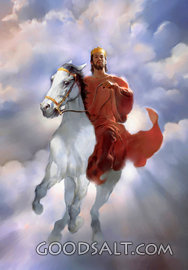
Revelation 19:11 NASB And I saw heaven opened, and behold, a white horse, and He who sat on it is called Faithful and True, and in righteousness He judges and wages war.
Here, though, is probably where many errors in understanding begin because it describes Him returning and tells us that He judges and wages war. The not so discerning perceive “He judges” to mean that of those thrones to be set up, Christ's is one of them and now he sits on the throne in judgment for the next thousand years I suppose.
Consider what has taken place.
What we mistakenly call the tribulation, years of God's wrath and judgment poured out upon the nations and Israel for rejecting Him, quite probably initiated by the rapture, has just ended.
I feel like I have to take a moment here and define something. Why would it be proper to say that the time of wrath/judgment may have been triggered or initiated by the snatching away of the church?
Romans 5:9 Much more then, being now justified by his blood, we shall be saved from wrath through him.
1Thessalonians 1:10 And to wait for his Son from heaven, whom he raised from the dead, even Jesus, which delivered us from the wrath to come.
1Thessalonians 5:9 For God hath not appointed us to wrath, but to obtain salvation by our Lord Jesus Christ,
Because of these “witnesses”, I see credible evidence telling me that as a believer/follower of Jesus Christ, that I, nor you if you follow Christ, are going to be subject to the wrath that is coming. Can you also see why it is important to label the time frame as it is meant to be, a time of wrath, not tribulation? Oh certainly, tribulation will be a part of it as it has always been for the believer. Maybe, that has been a problem too, as we invite people to Christ indicating that all their problems will go away. Sure, I want you to come to Christ primarily because you are loved and have a hope and future with the Father in eternity. But get real, you are signing up for warfare. Perhaps I need say nothing more than what Jesus said?
Matthew 10:34 KJV Think not that I am come to send peace on earth: I came not to send peace, but a sword.
Take the time to read Matthew 10:34 – 42, it will open your eyes.
Since God and Jesus are the same, then we could just as easily say that the last seven years have been Jesus judging the earth. Many will call this a stretch, so let's see if we can find something more concrete for you.
Since much of what I have just mentioned comes out the Revelation, what does it say?
“The Revelation of Jesus Christ, which God gave Him to show to His bond-servants, the things which must soon take place; and He sent and communicated it by His angel to His bond-servant John,” (Revelation 1:1 NASB)
So the entire book then is a Revealing of Jesus Christ. Therefore, any application of God in the book is really talking about Jesus, because they are the same and in union with each other.
Then there is that whole event on the cross; what do you do with that?
While there is no denying that, as Matthew's gospel puts it, He comes in Glory - which happens to mean judgment. But judgment for what?
Not sin, that was taken care of on the cross, as Jesus became sin for us.
“Sin” is such a lousy word for merely not hitting the center ring of a target, especially when you are having to compensate for everyday life events that act like sudden gusts of wind moving your hands off-center just as you release your shot or, you are sixty-two years old, as I am, and now your hands are starting to shake. How naughty of you! Get real, at least some of us are trying.
After reading scripture for all these years I feel like I can put the puzzle together because I have so many of the pieces. My problem is, I do not remember while I got the puzzle pieces from. Because of my memory slipping gears on me, I begin by doing searches for keywords I know are related to the subject. Since that did not work as well as I hoped, in this case, I sat there pondering for a moment. It is often in those moments, when I am quiet, that the Holy Spirit speaks. In this case, I was reminded to look in the letter to the Hebrews. (To you Gentiles, which is about all of us, this entire letter was written with the Jewish community in mind.)
For if the word spoken by angels was steadfast, and if every transgression and disobedience received a just recompense of reward, how shall we escape if we neglect so great a salvation, which at the first began to be spoken by the Lord, and was confirmed unto us by those who heard Him; (Hebrews 2:2-3 MKJV)
Since sin, the damaged condition we carry that required the payment of blood, was preventing us from a relationship with God, because it put us in the ownership of Satan, then someone had to pay the price for our freedom from this indebtedness and separation. Since there was no one on earth capable of doing that God sent his Son, untainted by what seems to be a genetic disposition to fail by sinning. That was Jesus Christ; And, He did it perfectly. His payment of his own blood purified us and paid for the freedom of us all.
What then would prevent a human from entering into heaven?
Well, just what the writer of the letter to the Hebrews said, to neglect so great a salvation. You, of course, are intelligent people and know full well what neglect is , don't you? Really it is as simple as the child, who hears the request/demand to take out the trash, but, for whatever reason does not. They have neglected to do so. A synonym for neglect is to disregard. Now I understand, as foolishly disregarding a road sign that indicates there is danger ahead due to the road being destroyed by a flood can cost you your life.
I said all that to say, it is only our own bad choice to disregard God's voice calling you to him that will put you through the eternal separation called hell.
Read Revelation 19 and 20 to get the full picture, but since we are talking about Christ sitting upon a throne where do we see a throne or thrones after the time of judgment?
Revelation 20:4-5 MKJV And I saw thrones, and they sat on them, and judgment was given to them. And I saw the souls of those who had been beheaded for the witness of Jesus and for the Word of God, and who had not worshiped the beast nor his image, nor had received his mark on their foreheads, nor in their hands. And they lived and reigned with Christ a thousand years. (5) But the rest of the dead did not live again until the thousand years were finished. This is the first resurrection.
I do not see one throne set up with just Jesus seated as a king that judges. I see many thrones; as many as there are martyred saints.
“ the souls of those who had been beheaded for the witness of Jesus and for the Word of God, and who had not worshiped the beast nor his image, nor had received his mark on their foreheads, nor in their hands”
This horrific act of being martyred because your beliefs were different or challenged your oppressors, has happened to many already and it is not even the time of wrath yet; what happens to them?
1 Thessalonians 4:15-17 MKJV (15) For we say this to you by the Word of the Lord, that we who are alive and remain until the coming of the Lord shall not go before those who are asleep. (16) For the Lord Himself shall descend from Heaven with a shout, with the voice of the archangel and with the trumpet of God. And the dead in Christ shall rise first. (17) Then we who are alive and remain shall be caught up together with them in the clouds, to meet the Lord in the air. And so we shall ever be with the Lord.
Does all this mean that Christ will not be seated in the New Jerusalem during the thousand-year reign?
Not at all, for He will be the light.
Revelation 22:5 NASB And there will no longer be any night; and they will not have need of the light of a lamp nor the light of the sun, because the Lord God will illumine them; and they will reign forever and ever.
You need to spend time in the Word of God for yourself, for in that book all truth is found.

Monday, January 11, 2016

There are obviously those that make it through the tribulation

I have something I need to talk about. Hopefully, I can keep it short. This has more to do with a question I have been asked repeatedly. I try to answer the question, but, because of tradition, bad teaching, or a lack of desire to pursue the answers, the question keeps coming up.
The question goes something like this,
"There are obviously those that make it through the tribulation. Are they saved?"
I thought about it for a second and then I responded with, what does it mean to be saved? He answered back with,
“You know, saved!”
No, I don't know. However, if you are trying to say that these survivors, based merely on the merit of making it through to the end of the “tribulation”, are comparable to finding salvation in Christ, then the answer is NO. If you think of salvation in terms of pulling someone out of a fire, then, YES, I think they are. How do I equate making it through the hell of the tribulation years to getting pulled out of a fire? It's easy, they will both kill you.
So the essential question that needs definition is, what does salvation mean? But that is not what you are asking me is it. You already have this crazy notion of what things look like and want me to validate it. Well, that is not going to happen. I am going to try to get you to look at the truth, which I deem to be the word of God.
Sadly, even using the Word of God as the source of truth creates a problem. The problem is that the answers to your question are not neatly packaged in one place, so this forces both of us to do our homework, and, we have to have open minds about the answers we find. Lacking that, you are no better off than a rock.
Often, when I try to respond with an answer, most remove logic from the equation and dismiss scripture as the foundation of truth. Having attempted an answer I referred the person asking to Matthew 25. I did this because he opted to change biblical history by putting the great white throne judgment immediately before the 1000 year reign. He quickly opened the bible program on his cell phone and read Matthew's account back to me.
When the Son of Man comes in his glory, and all the angels with him, then he will sit on his glorious throne. Before him will be gathered all the nations, and he will separate people one from another as a shepherd separates the sheep from the goats”.
An interesting representation of the throne.
"So there it is. He gathers the nations before him and judges them."
Yep, it says that. However, it does not tell you when that takes place. It does not explain that this throne is the same throne that we see in Revelation 20, and, there is nothing to indicate that these are souls that have died from at least Christ's resurrection forward; Neither does it make any clarification as to who they are or how they got there; Besides all that, and contrary to popular belief, not all are sent to an eternal punishment.
I want you to understand what I perceive the original question to be:
“ those that make it through the tribulation, are they saved?”
Because I told this person to look at Matthew 25, I want you to look there also.  Before you jump into Matthew 25 you need to understand that there is a context to what Jesus said.
  1. What we see in Matthew 25 is a continuation of a response that started in Matthew 24:1.
  2. The things that motivated the disciples question really began in Matthew 21 as they placed him upon the colt. Ask yourself why that would be significant.
  3. So what happened between them placing him on the colt, leading him into town in Matthew 21, and the end of Matthew 23 that would prompt them to say, when will these things happen and what will be the sign of your coming as the Messiah we anticipated (My version.)
In Matthew 21, at his direction, the disciples went and took the donkey and it's colt. This was finally it. Jesus was going to step up as the Messiah they anticipated for every king triumphantly rode into town like this, but that did not happen. After all the fanfare and adulation Jesus sees the money changers in the outer court of the temple (this was a weekly occurrence, but today it pushes him over the edge), so he makes a whip of cords and drives them out. This, of course, brought the wrath of the Chief priests and elders upon him, and he battled with them verbally for two days. We seem to forget that the disciples were right there; they had no place else to go (we assume).
Jesus finally says to the disciples, let's go to the mount. It was his favorite place to rest and recover when he was in Jerusalem, and it is only a short distance away from the temple.
The disciples, discouraged, disillusioned, fatigued by the intercourse are now grateful to get out of harms way. Trudging along behind him they try to lighten the mood by pointing out how great the temple was, and at this point, they were making comments about it's massive stones. Sadly, Jesus, the true temple, was standing right there and they did not yet realize it. I happen to think this understanding plays a role in how Jesus responds. Thus begins a rather long discourse and the answers to some very Jewish questions.
Matthew 25:31-46 is an aspect of Jesus response, and is to be taken in context. In the context timing is everything and the timing has everything to do with, when will you come back as the Messiah we were hoping for?
Matthew 25:31-46 ESV "When the Son of Man comes in his glory, and all the angels with him, then he will sit on his glorious throne. Before him will be gathered all the nations, and he will separate people one from another as a shepherd separates the sheep from the goats. And he will place the sheep on his right, but the goats on the left. Then the King will say to those on his right, 'Come, you who are blessed by my Father, inherit the kingdom prepared for you from the foundation of the world. For I was hungry and you gave me food, I was thirsty and you gave me drink, I was a stranger and you welcomed me, I was naked and you clothed me, I was sick and you visited me, I was in prison and you came to me.' Then the righteous will answer him, saying, 'Lord, when did we see you hungry and feed you, or thirsty and give you drink? And when did we see you a stranger and welcome you, or naked and clothe you? And when did we see you sick or in prison and visit you?' And the King will answer them, 'Truly, I say to you, as you did it to one of the least of these my brothers, you did it to me.' "Then he will say to those on his left, 'Depart from me, you cursed, into the eternal fire prepared for the devil and his angels. For I was hungry and you gave me no food, I was thirsty and you gave me no drink, I was a stranger and you did not welcome me, naked and you did not clothe me, sick and in prison and you did not visit me.' Then they also will answer, saying, 'Lord, when did we see you hungry or thirsty or a stranger or naked or sick or in prison, and did not minister to you?' Then he will answer them, saying, 'Truly, I say to you, as you did not do it to one of the least of these, you did not do it to me.' And these will go away into eternal punishment, but the righteous into eternal life."
While I did not quote the verse in rebuttal, there is no doubt that it says, “When the Son of Man comes in his glory, and all the angels with him, then he will sit on his glorious throne. Before him will be gathered all the nations,”. If all you ever read was this, you could build a variety of themes around it, and be rather convincing.
Here is one of the aspects of this verse that give people trouble: Before him will be gathered all the nations,” 
Do you understand that there are only three people groups (as far as God is concerned) in the bible narrative? They are:
  • The Jews – Israel
  • The nations – Also called the gentiles. This is literally anyone outside of Christ – those who refuse to follow him.
  • And, the church. The church is the followers of the Messiah, Jesus Christ. He is not a gentile god, He is God and he is Jewish. Those of us who have accepted that he paid a price for us have been adopted in; we Gentile believers were at that point grafted into the root stock – Israel. Paul explained that having accepted him, he accepted us and made us be in Him.
So, God calls all those outside of a relationship with Jesus the nations.
Note: in the Revelation all that happens there is a revealing of Jesus, and therefore, substantiates that Jesus is God.
I told the person asking me the question, that Revelation 20 is the same story as we see in Matthew 25. There will be some obvious differences, but I will attempt to explain.
Revelation 20:1-3 ESV Then I saw an angel coming down from heaven, holding in his hand the key to the bottomless pit and a great chain. (2) And he seized the dragon, that ancient serpent, who is the devil and Satan, and bound him for a thousand years, (3) and threw him into the pit, and shut it and sealed it over him, so that he might not deceive the nations any longer, until the thousand years were ended. After that he must be released for a little while.
When does this take place? After the tribulations of the seven years (it may not be a precise seven-year period.) Read Revelation 19: 17-21. There you will see Jesus coming back with a mighty army and all those who choose to fight against God will be slain. In Ezekiel, we find that the new Jerusalem comes down out of heaven and the martyred reign with Christ during the thousand years. Are they holding judgment over the nations as we see in Matthew's account? No. With Satan bound for a thousand years, any evil done is purely the creation of man's desire, and that will continue to happen. I believe that they will keep rein over that kind of nonsense. Keep in mind, all oppression shall cease.
Revelation 20:4 ESV Then I saw thrones, and seated on them were those to whom the authority to judge was committed. Also, I saw the souls of those who had been beheaded for the testimony of Jesus and for the word of God, and those who had not worshiped the beast or its image and had not received its mark on their foreheads or their hands. They came to life and reigned with Christ for a thousand years.
Since we already saw these in heaven (Revelation 6:9) why are they identified here as having come back to life? The assumption, and I think it is a pretty good one, is that the souls are reunited with the body. Consider that after his death Jesus cooked some fish for the boys and ate with them. So that same body that can eat fish and apparently enjoy it can still walk through walls.
So let's address the major point of contention. The argument started with the idea that at the beginning of the millennial reign is where Jesus sets up the great white throne, judges all survivors, and sends them all off to hell.
Is that what we see here in Revelation 20:4? No, instead of one throne there are many, and instead of one person, as in Jesus, all the martyred take part in the judgment.
  • Instead of one throne, there are many.
  • Instead of Jesus doing the judging, the martyred take part.
You will not see the multiple thrones or the martyred judging with Jesus in Matthew's account, and, if you only look for the final judgment, you will not find these extra thrones or the martyred in Revelation 20:11-15 either. You have to piece the puzzle together in it's context.
Then I saw a great white throne and him who was seated on it. From his presence earth and sky fled away, and no place was found for them. And I saw the dead, great and small, standing before the throne, and books were opened. Then another book was opened, which is the book of life. And the dead were judged by what was written in the books, according to what they had done. And the sea gave up the dead who were in it, Death and Hades gave up the dead who were in them, and they were judged, each one of them, according to what they had done. Then Death and Hades were thrown into the lake of fire. This is the second death, the lake of fire. And if anyone's name was not found written in the book of life, he was thrown into the lake of fire.” (Revelation 20:11-15 ESV)
Here are a few more points to consider as you contrast and attempt to grasp the context of the final judgment and where it is placed in time.
  • In Matthew, we find a glorious throne (a place of dignity and glory) instead of the great one (indicating it's size or prominence) we see in Revelation 20. 
  • Matthew 25:32 "Before him will be gathered all the nations." Now look at how John describes those standing before him in Revelation 20, "and I saw the dead, great and small, standing before the throne, and the books were opened". In both instances, no one is left out.
  • In Revelation 20 the crowd is separated according to their deeds found in the books. Matthew 25 shows the Son of Man separating them into sheep and goats. We must assume that the sheep are those whose names are found in the books.
This recurrent event is very intentional and meant to register quickly in the mind of the Jewish reader/hearer. Why? Because repetition is the accepted pattern for prophecy to the Jews, and this book we call the bible is a very Jewish book.
In Revelation 20:12 we see books opened, and the book of life.
Revelation 20:12 ESV And I saw the dead, great and small, standing before the throne, and books were opened. Then another book was opened, which is the book of life. And the dead were judged by what was written in the books, according to what they had done.
Catch the distinction here. In Revelation 20, the dead are judged out the books based upon what was written in them, according to what they had done. However, in Matthew's account, there is no mention of any books. Question: Does a difference in the stories make them invalid when we try to use them to corroborate these events? Not at all. Revelation always seems to be read from the viewpoint of an angry God, while Matthew is portrayed as the gentle shepherd.
Is there a comparable result? Yes.
Revelation 20:15 ESV And if anyone's name was not found written in the book of life, he was thrown into the lake of fire.
While in Matthew's account we find:
Matthew 25:41 ESV  "Then he will say to those on his left, 'Depart from me, you cursed, into the eternal fire prepared for the devil and his angels.
Jesus, the shepherd, explains to them how they did no good works and what that looked like. What amazes me is the simplicity involved in these works. It all boils down to this, step outside of your selfishness and show some kindness. 
For I was hungry and you gave me food, I was thirsty and you gave me drink, I was a stranger and you welcomed me, I was naked and you clothed me, I was sick and you visited me, I was in prison and you came to me.'
(Matthew 25:35-36 ESV)
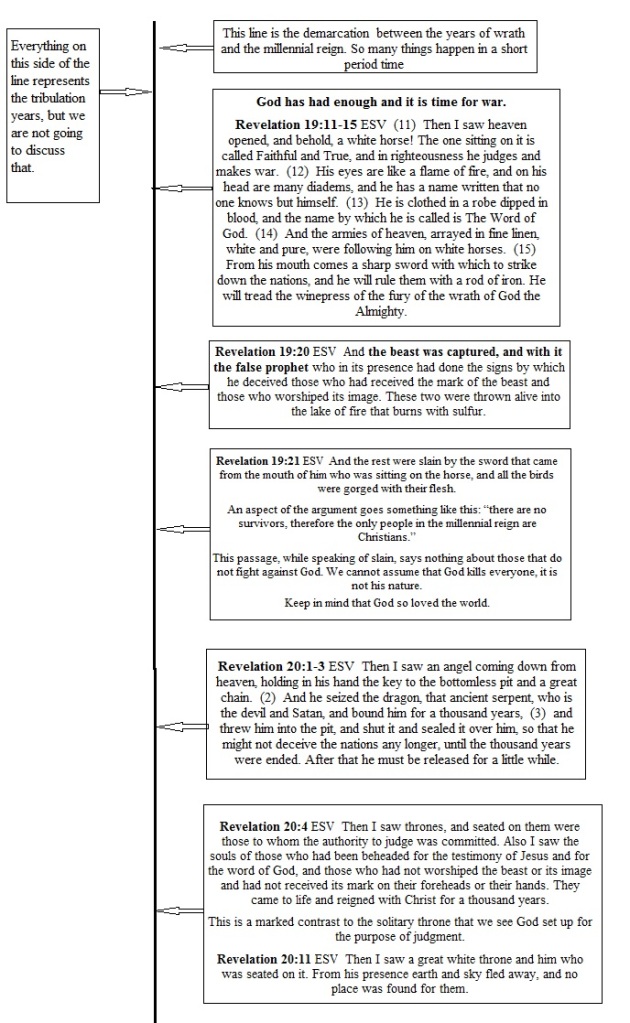
Perhaps all of this will be easier to understand if we can see it in a timeline format. Note: This is only attempting to show a short window of time from the moment Jesus physically returns to the earth, and the beginning of the 1000 year reign.
Timeline as we enter the 1000 year reign.

Featured Post

Will we have to go through the tribulation?

Then I heard a loud voice from the temple, saying to the seven angels, "Go and pour out on the earth the seven bowls of the wrath of...