Showing posts with label Assyria. Show all posts

Saturday, March 2, 2019

Micah 6:9, the armies of destruction are coming.

It has been a rough week and I needed to spend some time the Father.

Micah 6:9 NLT  Fear the LORD if you are wise! His voice calls to everyone in Jerusalem: “The armies of destruction are coming; the LORD is sending them.
Without explanation, let's break this down.
  • Fear the LORD if you are wise! Words of wisdom, no matter who you are, or, what you are doing. Notice how it says if; perhaps we should all look at this as one of those self-analyzing questions that now and again needs to be asked as you say, if I am found to be wise, let it be in your eyes Father. I guess that means that I recognize that He is your Father and that you need to hold the mirror of the word up frequently as you would a mirror and look in it.

  • His voice calls to everyone in Jerusalem:” The NET translation implies that this can also be read - “the voice of the LORD is calling.” Keil & Delitzsch, in their commentary on the Old Testament, state, “because Israel is altogether wanting in these virtues, the Lord must threaten and punish. Mic_6:9. “The voice of Jehovah, to the city it cries, and wisdom has thy name in its eye; hear ye the rod, and who appoints it!” With these words, Micah introduces the threatening and reproachful words of the Lord. It is not to be taken by itself, as an exclamation, “Hark! voice of the Lord!” as in Isa_13:4; Isa_40:6, but must be connected with what follows.”
The deadly nature of the warning comes next.
  • The armies of destruction are coming;” J. Vernon McGee attempted to give us a portrayal of Micah; it goes as follows. “We have seen that Micah has been directing his prophecies largely to the urban areas, to the cities. His writing reveals that he is a very sophisticated writer. He was in the know; he belonged to the upper echelon. He is in contrast to Amos who said, "I'm no prophet. I'm just a gatherer of sycamore fruit.” And yet, it was McGee that gave me this: “Micah the Moresthite means that he was a native of Moresheth of Gath, which is southwest of Jerusalem. Although he was in the kingdom of Judah, he prophesied to both kingdoms, but his main message was directed to the northern kingdom. I have often wondered about that. His contemporary, Isaiah, was a prophet to the southern kingdom;... You will never misunderstand Micah because he makes it very clear to whom he is speaking.”
If Micah had not told us, we would have never known of such a place called Moresheth in Judah. Isaiah the prophet, also from Judah, was born of influence and therefore had access to the court of kings and influential people. Isaiah's lifestyle, it seems, was not Micah's. As you can see above, Micah prophesied to the Northern Kingdom of Israel, where Samaria lay.

Many will read a passage like Micah 6:9 and only see the relatively immediate Assyrian destruction that is coming, first to Israel and, in time, to Judah. The Assyrian invasions that occurred throughout this period, beginning around 730 BC, and culminated in 701 BC against Judah, however, as Micah tells us, the Assyrian is coming again.

The next aspect should cause some to shudder.
  • the LORD is sending them.” The simplistic definition of this is that God is sending all that this “Assyrian” represents. In the passages from Micah 5:5-6, I see, not only a singular entity but again, fighting forces. That entity, I believe, is known to us as the Antichrist. Now, what of this “they” that rules Assyria with drawn swords and enters the gates of the land of Nimrod?
Micah 5:5-6 NLT  And he will be the source of peace. When the Assyrians invade our land and break through our defenses, we will appoint seven rulers to watch over us, eight princes to lead us.  (6)  They will rule Assyria with drawn swords and enter the gates of the land of Nimrod. He will rescue us from the Assyrians when they pour over the borders to invade our land.

Because we now should be able to make a strong tie between Micah 6:9 and Micah 5:5-6, we should able to grasp, at least minimally, some idea of this Assyrian and where he comes from. Let me help you by showing you a map.

Everything that is yellow, green or a blend of those colors comprised the Assyrian empire.
When Micah 5:5-6 speaks of Nimrod we are talking about the region that comprises modern-day Iraq.
To be honest, the first thing I thought of as I saw the name Nimrod was Jonah and Nineveh; these too were Assyrians. Unless you have been living in a cave then you are aware of the group, of which we seem to have no origins called ISIL, or their preferred name ISIS. With firearms lifted high, they entered the region that formerly was Nineveh and retook towns like Mosul – a town that sat on the outskirts of Nineveh after Americans “liberated” it in the Iraq wars.
In so many ways I can see ISIS fulfilling some of Micah's prophecy, but the greatest fulfillment is found in Ezekiel 38 and 39 when Gog, the leader of Magog, swarms over Israel and dies on the hills of that country.

 Keep your eyes on the Holy Land.

Friday, November 9, 2018

They covet ... houses, and take them away. A look at Micah 2:1-4

These studies on Micah started as personal readings as I had no understanding of Micah and who he was talking to. Having been accosted by a pastor who told me to stay away from Eschatology, I was thrilled to see that Micah spoke with precision about such things.

 Another aspect of Micah that has troubled me for years was the division of the Northern and Southern Jewish kingdoms, Israel in the north, and Judah in the South. I feel strongly that I have a clear picture of much of that.

The men I sit with several days a week, are always asking me what I am studying, that prompted me to turn my own questions and thoughts into something that might help someone else understand. I realize that much of scripture is self-evident, however, if you grew up in church, as I did, then you have a lot of tales, traditions, and false teachings to undo. Undoing these things takes some dedication on your part, and that lack of commitment to God's word becomes evident as the people around you will fight with you to maintain those tales and traditions.

Here it is November 9, 2018, and this morning we learned that a beautiful, peaceful, retirement community of Paradise, Ca. has pretty much burned to the ground. The lady who put up the video and showed you the destruction as they drove out of town to safety, continually said, "Oh my God!"  You see, the majority of us have just enough experience with a self-serving and convenient religion that we can fight back with religious terminology. We are not fooling anyone, for we have chosen to do what Israel not only did but still does, they turned their back on God. They will, however, just like the person on the street, fight to protect what they think is right. 

If I had one purpose it would be to get people interested and excited about reading the Word of God. I find it a fascinating journey, and I know the end of the story. 

Enough of this, on with the study. 
Micah 2:1 MKJV  Woe to those who plot wickedness and prepare evil on their beds! When the morning is light they practice it, because it is in the power of their hand.
  • Woe to those who plot wickedness."
    • and prepare evil on their beds!”
      • "because they have the power to do what they want.”
        Micah 2:2 MKJV  And they covet and seize fields, and houses, and take them away. And they oppress a man and his household, even a man and his inheritance.
        • they covet and seize fields, and houses, and take them away.”
           In a previous post on Micah, I made a point of talking about the things that would have motivated the prophet (you know, life.) For example: suppose God brings some Hells Angel motorcycle rider to Christ. That man would undoubtedly have a rough exterior until God is through refining the man (by the way, God won't be done perfecting us until we are changed just before entering heaven.) Micah had to deal with people like, King Ahab, who wanted the field of Naboth; a field which was profitable and happened to be next to the castle. Ordinary ploys at bartering did nothing to change the mind of Naboth, and so, Ahab's wife, who had the power in her hands to take it, had Naboth killed. There is no reason to think that Micah would not have found out about this, especially since Jezebel's actions brought a relatively swift judgment against her, and she was thrown out of an upper window, where she splattered and was eaten by dogs, leaving nothing to bury. This kind of action is high drama.
        • And they oppress a man and his household, even a man and his inheritance." By power wrest the estates out of the hands of the owners. This kind of action is precisely what I was trying to portray when I brought up Naboth.
        Seized property. The acquisition of property by oppressing the poor and weak violates both the law against coveting as well as the injunction not to violate the covenantal division of the land to each Israelite household after the conquest. Despite these laws, the mounting debt of small landowners and the political power exercised by large landowners led to abuses, which are mentioned in Egyptian wisdom literature (Instruction of Amenemope).[From the IVPBBC]

        Isaiah 5:8 MKJV Woe to those who join house to house, laying field to field, until the end of space, and you are made to dwell alone in the middle of the land!

        Oppressive real estate development. Expansion of real estate holdings in the ancient world was usually at someone else's expense. The story of Ruth is such a tale. Even though the Jews had laws which demanded that another Jew's property was to be returned after seven years, the Jewish investors looked for ways to get around these laws. In Israel, this was a theological as well as an economic crisis. Since God had given them the land as a benefit of the covenant, each family considered its landholdings as its little share in the covenant. Therefore, what otherwise would be a financial tragedy (often with an oppressive dimension) also served to deprive family members of their part in the covenant.

        Here in America, we had, several years ago, some lousy banking practices where they made sub-prime loans. These loans were made to people who would not be able to make their payments, and a deluge of people lost their homes to foreclosure.

        Micah 2:3 MKJV So Jehovah says this: Behold, against this family I am plotting an evil from which you shall not remove your necks; nor shall you go proudly, but it is an evil time.
        • against this family.”
        • I am plotting an evil from which you shall not remove your necks; ”
        • nor shall you go proudly, but it is an evil time.”
        Judges 2:15 MKJV Wherever they went out, the hand of Jehovah was against them for evil, as Jehovah had said, and as Jehovah had sworn to them. And they were greatly distressed.

        Jeremiah 8:3 MKJV And death shall be chosen rather than life by all the rest of those who remain of this evil family, who remain in all the places where I have driven them, says Jehovah of Hosts.

        Amos 3:1 MKJV Hear this Word that Jehovah has spoken against you, sons of Israel, against the whole family which I brought up from the land of Egypt, saying,

        Micah 2:4 MKJV In that day one shall take up a parable against you and mourn a mourning of mournings, saying, We shall be completely laid waste. He has exchanged the share of my people. How He has removed it from me! To the apostate, He has divided our fields.
        • In that day.”
          • We shall be completely laid waste.”
            Micah 2:4 ISV When this happens, someone will compose a proverb about you, lamenting sorrowfully, 'We are completely ruined! He has given my people's heritage to others. How he has removed it from me, dividing up our fields!'

            God restored Israel to their land; this restoration began to happen 1917 with the Balfour agreements. But Israel became an acknowledged nation in 1948. And yet, here again, Israel will be completely laid waste. To those who do not read the Bible, with the purpose of understanding, this makes no sense, and neither does God. We are told things like God is love, and because of love, God gave His only Son to die so that the world, through Him, could be saved.

            Why then does He not just save these people He calls his own?
            Note how I said, through Him, we could be saved. It is an open-ended invitation, and all one has to do is to walk through the door. Soon that door, which is now open, will be closed; and thus will end the age of Grace. Is the opportunity to find or come to Him still available? Indeed, but after the catching away of the church, you will have to prove your allegiance through your actions and testimony. In the face of some entity, like ISIS, you will probably lose your head. 

            Here in America, where loving God is on the verge of becoming a criminal act, you will probably be arrested and thrown into one the FEMA camps that are already set up across this nation. I failed to mention that during the seven years following the catching away of the church, the violence and animosity towards mere people will skyrocket. And none of this takes into account the destruction God will send upon the earth.

            How do I know this stuff? I have read my Bible and subjected myself to lousy Bible studies, that were so bad that I had to go home and study out what scripture had to say myself. My guess is you figured out that I am no Einstein; I am just a regular guy that has learned to rely heavily on God's grace and mercy.

            Monday, November 5, 2018

            A look at Micah. Chapter 1: 6-16. The end of chapter 1.

            May I be honest? There are some portions of the Bible that I find tedious, like the book of Numbers and these next few verses. Let's see if I can invest a bit of life into them.

            Micah 1:6 MKJV And I will make Samaria into ruins of the field, planting places for a vineyard; and I will pour down her stones into the valley, and I will uncover her foundations.

            This verse reminds me of another scenario in scripture, where it spells out the destruction of Damascus. Isaiah 17:1 tells us that Damascus will cease to be a city.

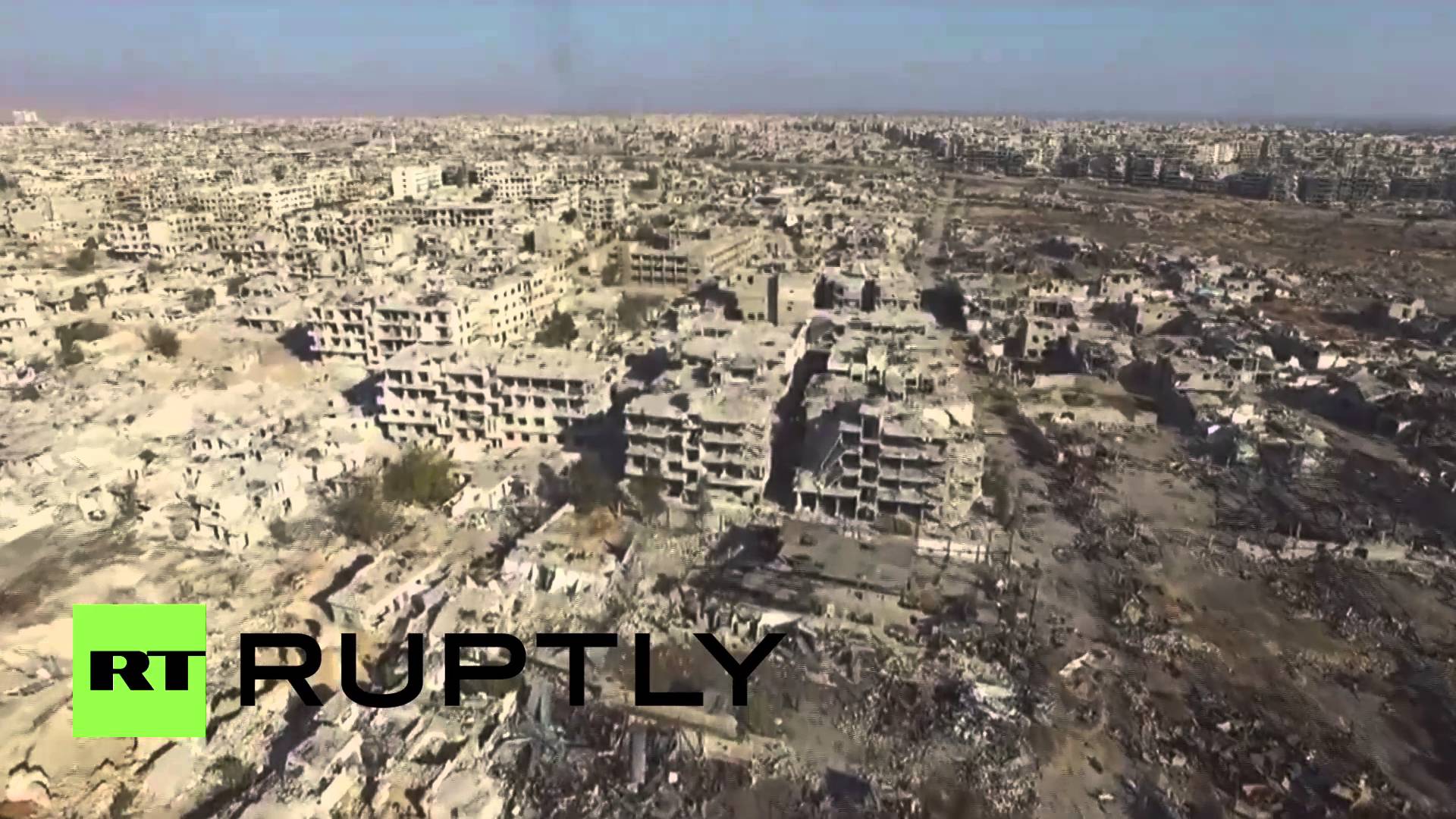
            Look at this picture of Damascus; If it is not yet uninhabitable, it will be soon.

            A Drone picture of Damascus that shows the destruction going on there; “no copyright infringement is intended.”
            The IVPBBC gives us this piece of information. “The Syro-Ephraimitic War which raged during the middle 730s ended with the Assyrian king Tiglath-Pileser III invading Syria and Israel and devastating both of these rebellious states (734-732). The Syrian kingdom ruled from Damascus by Rezin (see Isa_7:1-9), had been Israel's principal political and economic rival. He had meddled in Israel and Judah's internal affairs and had encroached on their territories for over a decade. It seems apparent, however, that Rezin overstepped his bounds in leading an anti-Assyrian coalition. Assyria did not welcome a rival “Greater Syria,” and the destruction of Damascus in 732, as recorded in the Assyrian Annals, was massive, leaving hundreds of sites looking “like hills over which the flood had swept.” This widespread destruction also included both the reduction of much of the city of Damascus to rubble as well as the redistribution of its territories in Syria as well as in Transjordan and the Galilee.”
            [The IVP Bible Background Commentary: Old Testament; Copyright © 2000 by John H. Walton, Victor H. Matthews, and Mark W. Chavalas]

            Apparently, the destruction is happening once again.

            Samaria.
            From ESV maps showing the range of the Assyrian empire. Note where Samariah is located, directly above Judah.
            Although I went into great detail about why there was such a hatred of Samaritans, I can't just walk away from the region because the Holy Spirit seems to keep drawing that area into the equation.
            Note: Samaria was taken by Shalmaneser (2Ki_17:6) B.C. 724; razed to the ground by Hyrcanus (Josephus, Ant. l. xiii. c. 18); restored by Herod, and called SebastĂȘ; and is now a small village called Sebusta, its ancient site being converted into gardens.

            So, we have learned that Samaria was taken all the way to the ground, and will, like Damascus, be destroyed again. One of the main problems I see with that area is that it sits in the Megiddo valley and Ezekiel 38,39 decree that the Megiddo valley will be filled with blood soon.

            Micah 1:7 MKJV And all her graven images shall be beaten to pieces, and all her gifts shall be burned with the fire, and I will destroy all its idols. For she gathered it from the reward of a harlot, and they shall return to the reward of a harlot.

            Let's consider two aspects of this verse for a moment.
            • And all her graven images shall be beaten to pieces, and all her gifts shall be burned with the fire.”
              • and I will destroy all its idols. For she gathered it from the reward of a harlot, and they shall return to the reward of a harlot.”
                And all the graven images thereof shall be beaten to pieces, ...By the Assyrian army, for the sake of the gold and silver of which they were, made, or with which they were adorned, as was usually done by conquerors to the gods of the nations they conquered; these were the calf of Samaria, and other idols; and not only those in the city of Samaria, but in all the other cities of Israel which fell into the hands of the Assyrian monarch;” see Isa_10:11; [John Gill's Exposition of the Bible]

                Micah 1:8 MKJV Therefore I will wail and howl; I will go stripped and naked; I will make a wailing like jackals, mourn like the daughters of an ostrich.

                [I will wail and howl] The prophet took up wailing because of the invader and the destruction of Judah and Jerusalem (Mic_1:8-16). [Dake]

                Dake's commentary wants us to believe that this is Micah, speaking about his actions and reactions. I have to remind myself that Micah is speaking under the influence of the Holy Spirit (even if he didn't know he was doing that,) on behalf of God. Micah is speaking God's heart. Why would God strip himself naked and wail like a jackal? That idea doesn't even seem reasonable. The bottom line here; I am not sure to whom I should assign these words. If it is Micah, he is indeed trying to make a point.

                Micah 1:9 MKJV For her wounds are not curable; for it has come to Judah; it has reached to the gate of My people, to Jerusalem.

                Interesting how the problem initiated with Samaria, in Israel, the Northern divided kingdom. Imagine that, God's people divided against themselves. Does that happen today? Oh sure, it happens all the time and churches will split over divisions.

                When we consider a wound, does it typically heal? Certainly. Now some things take longer than others, and, in war, a leg blown off does not grow back. Some spiders, on the other hand, leave you with necrosis, which, in some cases, will not heal.

                [wound is incurable] This expresses the fact that nothing could prevent her utter ruin, inasmuch as the nation had utterly filled up her measure of iniquity. [Dake]

                Micah 1:10 MKJV Do not declare it in Gath; weep not at all; in the house of Leaphrah roll in the dust.

                "Do not declare it in Gath" is interesting, as Gath is where Micah hails from, and eventually, so does Goliath.

                John Gill's commentary points out that this phrase is borrowed from 2 Samuel.
                2 Samuel 1:20 MKJV Tell it not in Gath, do not let it be known in the streets of Askelon, lest the daughters of the Philistines rejoice, lest the daughters of the uncircumcised triumph.
                One commentator stated, “why would you tell the enemy about the crushing punishment that was to be dealt out to their enemies; they would only laugh.”

                Micah 1:11-12 MKJV Pass over to them, O dweller of Shaphir, in nakedness of shame. The dweller of Zaanan has not gone out; the mourning of Beth-ezel shall take from you his standing. 12) For be grieved for good, the dweller of Maroth, for evil came down from Jehovah to the gate of Jerusalem.

                Joseph Benton's commentary communicates this: "Pass ye away, thou inhabitant of Saphir —Houbigant says that Eusebius places this city, the name of which signifies fair, or elegant, in the tribe of Judah, between Eleutheropolis and Askelon. Some think, however, that Saphir is not a proper name, and that there was no place so called in Judea; but that the clause ought to be rendered, Pass away, thou inhabitant of a delightful place, that is, Samaria, which was very pleasantly situated. The prophet here threatens the inhabitants of that place that they should go into captivity, in a way very unsuitable to their former softness and luxury, even stripped by the conquering enemy, and without so much as a covering to hide their nakedness. The inhabitant of Zaanan — A place in the tribe of Judah, called Zenan, Jos_15:37; came not forth in the mourning of Beth-ezel — “There was no burial of her dead with solemn mourning out of the precincts of her city, but she was besieged and put to the sword.” — Newcome. Or, the meaning may be, the inhabitants of Zaanan were so much concerned to provide for their own safety, that they took no notice of the mournful condition of their near neighbour Beth-ezel, which seems to have been a place near Jerusalem, termed Azal, Zec_14:5. Grotius, however, supposes Zaananto denote Zion, and Beth-ezelto signify Beth-el, called here by another name, importing the house of separation, because it was the principal seat of idolatrous worship. He shall receive of you his standing — The standing, or encamping of an army against the city; that is, the enemy shall encamp among you, shall stand on your ground, so that you will have no opportunity of coming out to the help of your neighbors. For the inhabitant of Maroth —A town in Judea, (the same probably that is called Maarath,Jos_15:59,)waited, &c.— Or rather, as the words may be translated, Although the inhabitant of Maroth waited for good, yet evil came, &c.,unto the gate of Jerusalem — Such a calamity as stopped not at Maroth, but reached even to Jerusalem. By Maroth, which signifies bitterness, or trouble, Grotius understands Ramah, or, expressed as it often is in the plural, Ramoth, a place in the tribe of Benjamin, near Beth-lehem, and not far from Jerusalem.

                Micah 1:13-15 MKJV O inhabitant of Lachish, bind the chariot to the stallion; she is the beginning of sin to the daughter of Zion, for the sins of Israel were found in you. 14) Therefore you shall give parting gifts to Moresheth-gath; the houses of Achzib are for a lying thing to the kings of Israel. 15) Yet I will bring an heir to you, O dweller of Mareshah. The glory of Israel shall come to Adullam.

                The following is from JosephBenson's Commentary on the Old and New Testaments
                O thou inhabitant of Lachish This was a strong fortress in the tribe of Judah: see Jos_15:39. Bind the chariot to the swift beast — In order to flee from the approaching enemy. Lachish was one of the first cities that Sennacherib besieged when he invaded Judea. She is the beginning of the sin to the daughter of Zion — She was the first among the cities of Judah which practised those idolatries which the kings and people of Israel had begun. Therefore shalt thou give presents to Moresheth-gath — Or, to Moresheth of Gath; that is, to the Philistines of that country, either to defend thee against the enemy or to receive thee under their protection. The houses of Achzib shall be a lie to the kings of Israel — The word Achzib signifies a lie. There was a town of that name in the tribe of Judah, mentioned Jos_15:44. This place, the prophet here foretells, will answer its name, and disappoint the kings of Israel that depended upon its strength and assistance: see 2Ch_21:3; and 2Ch_28:19. Israel is sometimes used for Judah, and so it may probably be taken here. Yet will I bring an heir unto thee, O inhabitant of Mareshah — This was another town belonging to Judah, mentioned Jos_15:44. The name signifies an inheritance; so here, by way of allusion, it is said, that a new heir or master should come and take possession of it, namely, a conquering enemy. He shall come unto Adullam the glory of Israel — Or, The glory of Israel shall come to Adullam; the Assyrians, whom Israel once gloried in as their ally, shall come to Adullam. This was a town in Judah not far from Lachish: see Jos_15:35. Some think the meaning of this clause is, that the chief men of Israel should be forced to hide themselves from their enemies in the cave of Adullam, as David did when he fled from Saul, 1 Samuel 23.

                Micah 1:16 MKJV Make yourself bald, and cut off your hair for the sons of your delight; make your baldness large like the eagle; for they go into exile from you.

                "By these phrases the prophet signifies, that the calamity would be so great as to deserve the strongest expressions of grief."

                [Make thee bald] Making the head bald in mourning was forbidden under the law (Deu_14:1), but since Judah had become like the heathen, she might as well mourn like them. Dake's commentary

                Cutting the hair, or shaving it close, were expressions of mourning and lamentation anciently used among most nations. Enlarge thy baldness as the eagle — When she molts her feathers; for they are gone into captivity, &c. — By these phrases the prophet signifies, that the calamity would be so great as to deserve the strongest expressions of grief. Joseph Benson

                Thursday, October 18, 2018

                A look at the book of Micah, an overview.

                As I told you in my previous post, I was recently in Emmett Idaho. On the ranch, there was no internet or phone service, and I was the volunteer groundskeeper for a week. My ability to post was non-existent. I managed to squeeze in a few minutes on the laptop computer, as I worked on the questions for a home group I am involved with and began looking at Micah while I was there.
                No one has asked me, but I will tell you whether you ask or not, as to how I come up with ideas for posts. My primary sources were “men's Bible study,” and some of the twisted messages that come from the pulpit. Since I have separated myself from much of that, I have to listen to the Holy Spirit and my friends for ideas. Sitting at the table on a peaceful morning, it occurs to me that I need to look into the book of Micah, and so I did.
                One other thing, I have no problem with using reasonable information from commentaries, Biblical dictionaries, and encyclopedias like the ISBE, as long as they ring true to what the Holy Spirit is trying to say. I know that last aspect is vague, but there are times when you open a resource, and immediately your gut responds with a NO, or at least, what is this person trying to say. Some, like a man I knew who has a Theological Doctorate, merely wants to fling large words around because it makes him sound important.
                On the book of Micah
                When I look at the overview of Micah, I am told, by almost every commentator, that little is known of the Prophet beyond his name, his place of origin, and the personal tone of his book. And yet, even I can find a historical setting which indicates that Micah's career extended from the reign of Jotham 752 BC to Hezekiah's reign which ended in 720 BC. Simple math could put Micah in the range of 50 years old at minimum.
                Street columns, Ancient Samaria.
                J. Vernon McGee tells us “There are many Micah's mentioned in the Scriptures, but this man is identified as a Morasthite, since he was an inhabitant of Moresheth-Gath, a place about twenty miles southwest of Jerusalem, near Lachish.”
                The book itself centers on the threat of the Assyrian invasions that occurred throughout this period, beginning around 730 BC, culminating in 701 BC against Judah.
                Micah 1:1 MKJV  The Word of Jehovah that came to Micah the Morasthite in the days of Jotham, Ahaz, and Hezekiah, kings of Judah, which he saw concerning Samaria and Jerusalem.
                From J. Vernon McGee – (Most commentators say the same thing.)
                “Micah the Morasthite means that he was a native of Moresheth of Gath, which is southwest of Jerusalem. Although he was in the kingdom of Judah, he prophesied to both kingdoms, but his main message was directed to the northern kingdom. I have often wondered about that. His contemporary, Isaiah, was a prophet to the southern kingdom; and perhaps, since Micah was probably a younger man, he felt that Isaiah could take care of the southern kingdom while God directed him to speak to the northern kingdom. You will never misunderstand Micah because he makes it very clear to whom he is speaking.”

                Still gleaning information from J. Vernon McGee -
                ...Samaria was the capital of the northern kingdom, Israel. The city was built originally by Omri, king of Israel, and was the seat of idolatry. It was made famous—or infamous—by Ahab and Jezebel who built there a temple to Baal. The city stood in a very lovely location, but it lies in ruins today... The desolate ruins bear mute testimony to the accuracy of Micah's prophecy concerning Samaria.”

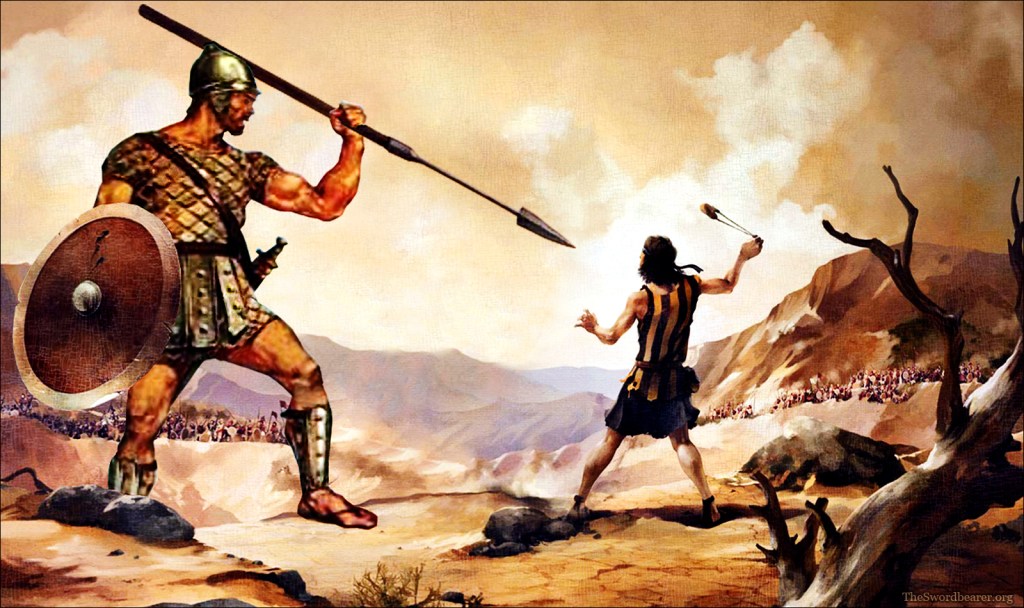
                Micah was from Gath; yes, the same place as Goliath.
                David, as something other than a child, facing Goliath.
                Brown-Driver-Briggs' Hebrew Definitions, tells us: mĂŽrashtı̂y - Morasthite see Moreshethgath = “possession of Gath” 1) an inhabitant of Moresheth.

                E.W. Bullinger helps to establish the beginnings of Micah's prophetic voice.
                “MICAH begins, apparently, a year or two before the end of Jotham’s reign, Isaiah, in that case, had already been prophesying some seventeen or eighteen years.”

                By comparing Micah 4:10 with Isaiah 39:5,6, we have another case of similar words occurring in two different prophets. Note that we are told that Micah also functioned during the days of Hezekiah; it may be presumptuous to assume that Micah prophesied to or against Hezekiah as Isaiah did.

                Then Isaiah said to Hezekiah, "Hear the word of the LORD of hosts, 'Behold, the days are coming when all that is in your house and all that your fathers have laid up in store to this day will be carried to Babylon; nothing will be left,' says the LORD. 'And some of your sons who will issue from you, whom you will beget, will be taken away, and they will become officials in the palace of the king of Babylon.'" Isaiah 39:5-7 NASB

                Continuing with Bullinger's exposition/commentary -
                "In this ease, the period covered by Micah and Isaiah was almost exactly the same (cp. Mic_1:1 with Isa_1:1; and see Appdx-77). It is no wonder that the circumstances did call for similar utterances, constituting a confirmation of the Word of Jehovah "by the mouth of two or three witnesses." Both were independent, without any idea of "copying" one from the other, as is alleged by the writer in The Encyclopedia Britannica, eleventh (Cambridge) edition, 1910, 1911, vol. xviii, p. 357, who says: "it is impossible that much, if any, of these chapters (Mic. 4-7) can be ascribed to Micah himself". This is said in the face of the fact that Jeremiah (Mic_26:16-19) definitely quotes and refers to Micah."

                Since Bullinger points out how similar Isaiah is to Micah, I choose to give you Isaiah 1:1 here.
                The vision of Isaiah, the son of Amoz concerning Judah and Jerusalem, which he saw during the reigns of Uzziah, Jotham, Ahaz and Hezekiah, kings of Judah. Isaiah 1:1 NASB
                Some notable differences would be Isaiah's reference to King Uzziah, something Micah did not do. Both are speaking toward Judah and Jerusalem; however, Micah chooses to use the term Samaria, which was the capital of the Northern kingdom.

                I want to add one more thing here –
                I have come to understand the Jewish concept of prophecy, and it does not include the flash and pizzazz we have become accustomed to. Prophecy is repeated patterns to the Jew, and the idea of two or three witnesses is an essential part of the verification process.

                The ISBE defines Uzzi'ah for us – His name means the (strength of Jehovah). King of Judah B.C. 809-8 to 757-6. In some passages, his name appears in the lengthened form Azariah: After the murder of Amaziah, his son Uzziah was chosen by the people, at the age of sixteen, to occupy the vacant throne; and for the greater part of his long reign of fifty-two years, he lived in the fear of God, and showed himself a wise, active and pious ruler. He never deserted the worship of the true God, and was much influenced by Zechariah, a prophet who is mentioned only in connection with him. 2Ch_26:5.

                Under the reign of Uzziah,
                ''the southern kingdom was raised to a condition of prosperity which it had not known since the death of Solomon. The end of Uzziah was less prosperous than his beginning. Elated with his splendid career, he determined to burn incense on the altar of God but was opposed by the high priest Azariah and eighty others. See Exo_30:7-8; Num_16:40; Num_18:7. The king was enraged at their resistance, and, as he pressed forward with his censer, he was suddenly smitten with leprosy. This lawless attempt to burn incense was the only exception to the excellence of his administration. 2Ch_27:2. Uzziah was buried "with his fathers," yet apparently not actually in the royal sepulchres. 2Ch_26:23.”

                A few other Prophets around this time frame.
                Isaiah 1:1 NASB The vision of Isaiah, the son of Amoz concerning Judah and Jerusalem, which he saw during the reigns of Uzziah, Jotham, Ahaz and Hezekiah, kings of Judah.
                Obadiah 1:1-2 NASB The vision of Obadiah. Thus says the Lord GOD concerning Edom--We have heard a report from the LORD, And an envoy has been sent among the nations saying, "Arise and let us go against her for battle"-- 2 "Behold, I will make you small among the nations; You are greatly despised.
                Nahum 1:1-3 NASB The oracle of Nineveh. The book of the vision of Nahum the Elkoshite. 2 A jealous and avenging God is the LORD; The LORD is avenging and wrathful. The LORD takes vengeance on His adversaries, And He reserves wrath for His enemies. 3 The LORD is slow to anger and great in power, And the LORD will by no means leave the guilty unpunished. In whirlwind and storm is His way, And clouds are the dust beneath His feet.

                The Word from Micah is concerning Samaria and Jerusalem.
                In considering Samaria, I am reminded of the hatred and racism that we see in the gospels, as the Jews would walk the longest way just so that they would not have to pass through Samaria. And then there was the interaction Jesus had with the Samaritan woman at the well. That well was within Samaria, and her comments pointed out some of the hatred and prejudice she lived with on a daily basis.

                Names that are mentioned: Jotham, Ahaz, and Hezekiah, several of which were Kings of Judah.
                The reason I emphasize the names is that they may give us some insight into why the Word came. Keep in mind; nothing is random or by accident; and, you cannot separate the Word given from the human emotions that are a part of the speaker, in this case, Micah. The idea here is to find the link and possibly the reasons behind the “Word” given by Micah.

                Jotham
                The ISBE tells us that Jotham was the - Twelfth king of Judah, son of Uzziah and Jerusha, daughter of Zadok (2Ki_15:32-38; 2Ch_27:1-9).
                Jotham was 25 years of age at the time of his father's attack of leprosy and was at once called upon to take the administration of the kingdom (2Ki_15:5; 2Ch_26:21). In doing this, he not only judged the people of the land by presiding at the administration of justice but also was over the household of the king, showing how complete was the isolation of his father. He was thus king in all but name and is invariably spoken of as reigning in Jerusalem. His reign lasted for 16 years (2Ki_15:33; 2Ch_27:1), 759-744 (others put later). While the father loved husbandry and had much cattle (2Ch_26:10) - external affairs with which he could occupy himself in his retirement - to the son fell the sterner duties and heavier responsibilities of the state.

                Ahaz
                Again we turn to the ISBE.
                “The name is the same as Jehoahaz; hence appears on Tiglath-pileser's Assyrian inscription of 732 bc as Ia-u-ha-zi. The sacred historians may have dropped the first part of the name in consequence of the character of the king.”
                Ahaz was the son of Jotham, king of Judah. He succeeded to the throne at the age of 20 years (according to another reading 25). The chronology of his reign is difficult, as his son Hezekiah is stated to have been 25 years of age when he began to reign 16 years after (2Ki_18:2). If the accession of Ahaz be placed as early as 743 bc, his grandfather Uzziah, long unable to perform the functions of his office on account of his leprosy (2Ch_26:21), must still have been alive. (Others date Ahaz later, when Uzziah, for whom Jotham had acted as regent, was already dead.)
                “Although so young, Ahaz seems at once to have struck out an independent course wholly opposed to the religious traditions of his nation. His first steps in this direction were the causing to be made and circulated of molten images of the Baalim, and the revival in the valley of Hinnom, south of the city, of the abominations of the worship of Moloch (2Ch_28:2, 2Ch_28:3). He is declared to have made his own son “pass through the fire” (2Ki_16:3); the chronicler puts it even more strongly: he “burnt his children in the fire” (2Ch_28:3). Other acts of idolatry were to follow.” [These acts are spelled out in detail in 2Chronicles 28.]

                Hezekiah
                Hezeki'ah. (the might of Jehovah). The ISBE informs us that he was the twelfth king of Judah, son of the apostate, Ahaz and Abi or Abijah, ascended the throne at the age of 25, B.C. 726. Hezekiah was one of the three most perfect kings of Judah. 2Ki_18:5. Sir_49:4. His first act was to purge, repair and reopen, with splendid sacrifices and perfect ceremonial, the Temple. He also destroyed a brazen serpent, said to have been the one used by Moses, in the miraculous healing of the Israelites, Num_21:9, which had become an object of adoration.”
                “He refused to acknowledge the supremacy of Assyria. 2Ki_18:7. The instant war was imminent Hezekiah used every available means to strengthen himself. 2Ki_20:20.”

                 “It was probably at this dangerous crisis in his kingdom, that we find him sick and sending for Isaiah, who prophesies death as the result. 2Ki_20:1. Hezekiah's prayer for longer life is heard. The prophet had hardly left the palace when he was ordered to return and promise the king immediate recovery and fifteen years more of life. 2Ki_20:4. An embassy coming from Babylon ostensibly to compliment Hezekiah on his convalescence, but really to form an alliance between the two powers, is favorably received by the king, who shows them the treasures which he had accumulated. For this, Isaiah foretells the punishment that shall befall his house. 2Ki_20:17.”

                Saturday, July 29, 2017

                Daniel chapter 11 - The Kings of the South and the North. Verses 1-4.

                Let me apologize for the lack of posts, as I have been working on other things since delivering this bible study. Also, since getting advice from a friend who used to moderate a blog site, I have been conscious of the length. Initially, I intended to post all of chapter 11, but if you were to print it out, it would be twenty pages long. It took me three weeks to deliver. And, as you will see, it comes off as a rather intense history lesson. Consider the way God delivers information and how He speaks about the future. This is precisely why critics have found it easy to say, this was written after the fact. That is not the case, and I attempted to make it clear through timelines, explanations, and the interjection of historical aspects.  

                Daniel chapter 11 - The Kings of the South and the North

                A history of the Middle East from Darius to the future Antichrist. Daniel 11:1-34
                Calvary Chapel Pastor David Guzik tells us, "This chapter contains one of the most specifically fulfilled prophecies of the Bible, predicting history over some 375 years and to the end of known time, with amazing accuracy.
                Chuck Missler agrees with David Guzik when he says, "That the chapter is so specific, that many critics and scholars who deny supernatural revelation, have insisted that it is history, written after the fact, fraudulently claiming to be prophecy."

                I realize we are working on chapter 11, but for the sake of understanding, How did Daniel 10 begin?
                Daniel 10:1 In the third year of Cyrus, king of Persia (550 -530BC), a message was revealed to Daniel.

                By comparison, how does Daniel 11 start out?
                Daniel 11:1 And in the first year of Darius the Mede (522-486BC), I stood to strengthen him and to provide protection for him.)
                • in the first year of Darius the Mede (522-486BC),
                  This is a chronological gap of over 25 years. While the statement, “in the first year of Darius the Mede,” might seem unimportant, Daniel gives us several clues. One clue speaks specifically to when this event happened. Since Darius the Mede is the third aspect of Nebuchadnezzar's statue, we know that a fourth empire is still coming. However, that fourth empire, if we attempt a chronological accounting, is Grecian. And, even then, after Alexander's death, there were four Grecian Generals who ruled in Alexander's stead. God, it seems, will bypass the four and focus on the lineage of the one that has the most significant impact on Israel.

                • Timeline from Nebuchadnezzar to Darius
                • I stood to strengthen him and to provide protection for him.”
                An alternate translation says I stood to be “an encouragement ...” This actually sounds like the character of Daniel.
                • "Him" is a reference to Darius.
                Isn't that odd? You would assume that God would be like us and only take care of His own. But, who is to say that Darius does not belong to God as well.
                In Isaiah, it says that God sent Israel to Babylon.

                Isaiah 43:14 NASB Thus says the LORD your Redeemer, the Holy One of Israel, "For your sake I have sent to Babylon, And will bring them all down as fugitives, Even the Chaldeans, into the ships in which they rejoice.

                In Jeremiah, Israel is told that they will be given into the hand of the king of Babylon.

                Jeremiah 20:4 NASB "For thus says the LORD, 'Behold, I am going to make you a terror to yourself and to all your friends; and while your eyes look on, they will fall by the sword of their enemies. So I will give over all Judah to the hand of the king of Babylon, and he will carry them away as exiles to Babylon and will slay them with the sword.

                Who arose or stood to strengthen him?
                In Daniel 10:19,20 we established that Gabriel was speaking, and may well be the speaker here. However, if this is Daniel speaking, in what ways could Daniel have sought or provided protection for Darius?
                While we have certainly perceived Daniel to be a purveyor of wisdom, to several captor kings, being a protector has never been implied. One thing you need to keep in mind is that Daniel has, while in Babylon, been under subjection to a series of kings that were willing to end your life in a hurry, especially if you were a captive slave.
                Four more kings over Persia before Alexander the Great.

                Daniel 11:2: "And now I will tell you the truth. Behold, three more kings are going to arise in Persia. Then, a fourth will gain far more riches than all of them; as soon as he becomes strong through his riches, he will arouse the whole empire against the realm of Greece."
                • "And now I will tell you the truth. Behold, three more kings are going to arise in Persia.”

                  Daniel 2:31-45. Nebuchadnezzar is the head of gold, Cyrus the Mede, the shoulders of silver, and Darius, the Persian, the chest of bronze.

                  Because the thighs and legs are made of iron and came after the Persian empire, it seems this is another.

                  three kings. Note: These were, Cambyses, son of Cyrus; Smerdia the Magian impostor, and Darius Hystaspes. The Ultimate Cross-Reference Treasury
                Matthew Henry's commentary tells us:
                He (Gabriel) foretells the reign of four Persian kings (Dan_11:2): Now I will tell thee the truth, that is, the true meaning of the visions of the great image, and of the four beasts, and expound in plain terms what was before represented by dark types. (1.) There shall stand up three kings in Persia, besides Darius, in whose reign this prophecy is dated, Dan_9:1. Mr. Broughton makes these three to be Cyrus, Artaxasta or Artaxerxes, called by the Greeks Cambyses, and Ahasuerus that married Esther called Darius son of Hystaspes. To these three, the Persians gave these attributes - Cyrus was a father, Cambyses a master, and Darius a hoarder. So Herodotus. (2.) There shall be a fourth, far richer than they all, that is, Xerxes, of whose wealth the Greek authors take notice. By his strength (his vast army, consisting of 800,000 men at least) and his riches, with which he maintained and paid that vast army, he stirred up all against the realm of Greece. Xerxes's expedition against Greece is famous in history as the shameful defeat that he met. He who when he went out was the terror of Greece, in his return was the scorn of Greece.

                With the understanding that we are using Darius as the baseline, Gabriel's comments logically pertain to those who come after Darius. However, we have already seen that God works outside our time frame, and He has little concern for chronology. We will see that this also pertains to a distant futurethat future is now.

                Timeline from Nebuchadnezzar to Darius
                "There were several kings of Persia after Xerxes, such as Artaxerxes Longimanus, Darius Nothus, Artaxerxes Mnemon, Ochus, and Darius Codomanus, but these are not enumerated because the real ground of the invasion of Alexander, the thing which connected him with the affairs of Persia, did not occur in their reign, but it was the invasion of Greece by Xerxes." Albert Barnes' Notes on the Bible

                Daniel 11:2: “... he will stir up everyone against the kingdom of Greece.”
                  • Xerxes did just that.
                    The LASB has an intriguing comment: "The fourth Persian king may have been Xerxes I (also called Ahasuerus, 486-465 B.C.), who launched an all-out effort against Greece in 480 BC.
                    This is the same king we see in the story of Esther.
                Esther 1:1 - "The following events happened in the days of Ahasuerus. (I am referring to that Ahasuerus, who used to rule over a hundred and twenty-seven provinces extending all the way from India to Ethiopia." ) NET Bible

                A mighty King, Alexander the Great” Dan 8:21
                Daniel 11:3 "And a mighty king will arise, and he will rule with great authority and do as he pleases.

                Mighty is the Hebrew word gibbôr, which means powerful; by implication, warriortyrant. The disconcerting aspect of this word is that it was also used of the Nephaliim. This might imply that Alexander was also a giant.

                Daniel 7:6 "After this I kept looking, and behold, another one, like a leopard, which had on its back four wings of a bird; the beast also had four heads, and dominion was given to it.

                The beast having four heads is another clue that takes us back to Alexander's generals, who take over after his death.

                Focusing on the word dominion.

                H7985 - soltan: An Aramaic masculine noun meaning dominion, sovereignty. Most frequently, this noun is used in conjunction with God, showing that He has dominion over everything that exists (Dan_4:3 [3:33]; Dan_4:34 [31]). His dominion is greater than that of a person's many ways, one being that it is an everlasting dominion that can never be destroyed (Dan_7:14). This noun can also be used of kings (Dan_4:22 [19]). It was used in Daniel's dream of the four beasts to describe the dominion they have (Dan_7:6, Dan_7:12, Dan_7:26). Much less frequently, this word can be used in the concrete sense of a physical kingdom (Dan_6:26 [27]).

                Daniel 8:5-8 "While I was observing, behold, a male goat was coming from the west over the surface of the whole earth without touching the ground; and the goat had a conspicuous horn between his eyes. 6) He came up to the ram that had the two horns, which I had seen standing in front of the canal, and rushed at him in his mighty wrath. 7) I saw him come beside the ram, and he was enraged at him; and he struck the ram and shattered his two horns, and the ram had no strength to withstand him. So he hurled him to the ground and trampled on him, and there was none to rescue the ram from his power. 8) Then the male goat magnified himself exceedingly. But as soon as he was mighty, the large horn was broken; and in its place there came up four conspicuous horns toward the four winds of heaven."

                Note that none could rescue the ram from his power. The large horn represents Alexander's reign. Broken, it was replaced by his four generals.

                Daniel 8:20-21 "The ram which you saw with the two horns represents the kings of Media and Persia. 21) "The shaggy goat represents the kingdom of Greece, and the large horn that is between his eyes is the first king.

                I happen to believe the two horns represent the Seleucid and Ptolemaic empires, the last of the Alexandrian empire.

                The Division of Alexander's/Grecian empire into four kingdoms. Dan 8:22

                Daniel 11:4 "But as soon as he has arisen, his kingdom will be broken up and parceled out toward the four points of the compass, though not to his own descendants, nor according to his authority which he wielded, for his sovereignty will be uprooted and given to others besides them."

                Alexander only ruled for 13 years (336-323BC.)

                From Wikipedia: “According to a Babylonian astronomical diary, Alexander died between the evening of June 10 and the evening of June 11, 323 BC, at the age of thirty-two. This happened in the palace of Nebuchadnezzar II in Babylon. Proposed causes of Alexander's death included alcoholic liver disease, fever, and strychnine poisoning. According to the University of Maryland School of Medicine report of 1998, Alexander probably died of typhoid fever (which, along with malaria, was common in ancient Babylon). In the week before Alexander's death, historical accounts mention chills, sweats, exhaustion and high fever, typical symptoms of infectious diseases, including typhoid fever. [”https://en.wikipedia.org/wiki/Death_of_Alexander_the_Great]

                Alexander's kingdom was parceled out to four generals, who were overtaken by Ptolemy to the south and Seleucus in the north.
                  • ..though not to his own descendants.”
                    From the IVPPBC: “Alexander died in 323BC, at the age of 33; a twenty-year struggle for succession ensued that eventually led to a four-way division of the empire. Two of those divisions were in the Aegean region (Cassander had Greece and Macedonia; Lysimachus had Thrace), while the other two divided up the Near East (Ptolemy had Egypt and Palestine; Seleucus had Syria, Mesopotamia and Persia). The Ptolemaic line is going to be represented by “the king of the South,” while the Seleucid line will be represented by “the king of the North.”

                Friday, July 28, 2017

                Daniel chapter 10 commentary and notes for Bible study

                While a commentary on Daniel chapter 10 may seem uneventful, it was a part of my preparation for Bible study with the men. You see I am just like most of you, a guy who has wanted to understand what I read and its relationship to what is going on around me. I guess that makes me an eschatology person. The guys I sit with call me the expert; I am hardly an expert and I had a religious life filled with presuppositions. Church, while being the place where much of the mental abuse came from, did give me a deep understanding that God loved me; that love trailed me like a hound as I rebounded from hurt to hurt and struggled to free myself from co-dependency - I didn't even understand what that was until a few years ago. As many of you know I put myself in a recovery group called Celebrate Recovery which uses many of the same principles as AA. I did this because my wife wanted me to get help for my rage, and I wanted help as well. For a short period, I worked the information table. There I noticed the paperwork for men's co-dependency and read it; it was pathetic and lacking. You get the impression that men are not allowed to either have or admit that they are co-dependent. The women's brochure, however, had about 30 lines of descriptives. I found myself in about 29 of those descriptions.

                Now, several years later, with time spent going through the steps multiple times, and even leading several groups, I am much better than I was. I can apply that same understanding to God's word and its application to my life and the world around me. Having gone through the Bible several times and gaining help from others, such as Joel Richardson, the author of the Islamic Antichrist. I now have a firm grasp on the nature and character of Christ, and, the apocryphal books of the Bible are not only something I can grasp but exciting, as we are living in those times now.

                This last sentence is what I try to convey to those who will listen. God, is a God of mercy; if that were not the case we would all be dead now. He loves you and desires a restored relationship with you. If He is a jealous God, it is because we have given our love to the things of this world. Jesus is the Messiah.

                Daniel Chapter 10

                Daniel 10:1 In the third year of Cyrus king of Persia a message was revealed to Daniel, who was named Belteshazzar; and the message was true and one of great conflict, but he understood the message and had an understanding of the vision.

                chronology. The third year of Cyrus's rule in Babylon was 537/536. This is very close to the time when the first wave of Jews are returning from captivity and beginning the rebuilding of the temple (recorded in the first chapter of Ezra). Dan_10:4 indicates that the vision took place on the twenty-fourth day of the first month (Nisan). This would be in early April. The celebration of Passover and the Feast of Unleavened Bread (14-21 Nisan) IVPBBC

                The importance of this is that Daniel is a devout Jew, and little would stop him from participating in the Passover.
                Daniel chapter nine opened with, in the first year of Darius.” So this is not a chronological recounting of Daniel's dreams, visions, and encounters.

                Cyrus killed Belshazzar, quite possibly a son of Nebuchadnezzar (This is the kind statement you make when you have not done your homework. Shortly after this, I did an in-depth study into Daniel chapter 11, where I was compelled to pay attention to background details. It is found in Scripture where God calls Nebuchadnezzar father, but further exploration informs you that it was a sign of respect to call male relatives/elders father.) The implications of the word father are that Belshazzar was related to Nebuchadnezzar. None-the-less, Belshazzar is now dead.

                Daniel 5:1. Belshazzar was the son and coregent of Nabonidus, the last king of Babylon. Nabonidus spent ten years in Teima while his son was carrying out all the royal duties in Babylon. A number of documents have been found that mention him by name. About thirty years have passed since the last chapter. Nebuchadnezzar died in 562, and the banquet of this chapter takes place in October 539. IVPBBC
                • a message was revealed to Daniel”
                  Message - It signified spoken words or speech (Gen_11:1; Isa_36:5; Jer_51:64
                • the message was true and one of great conflict”
                  The word true is the word 'emeth - stabile; figuratively certain, truth, trustworthy.
                  Conflict is the Hebrew word tsâbâ' and conveys the idea of a mass of persons organized for war.
                • but he understood the message”
                  Understood is the Hebrew word bı̂yn and means to separate mentally. It also implies to consider.
                • "and had an understanding of the vision."
                  If someone were to say to me, I have an understanding, the implications to me are, that you only have a partial comprehension. However the phrase "had an understanding" derived from the Hebrew word bı̂ynâh means to perfectly understand.
                Daniel 10:2-3 In those days, I, Daniel, had been mourning for three entire weeks. 3) I did not eat any tasty food, nor did meat or wine enter my mouth, nor did I use any ointment at all until the entire three weeks were completed.
                • Mourn.
                  The Hebrew word ’aḇal: It is a verb that means to mourn. The Word Study Dictionary tells us that the word implies, “Those who mourn are persons who mourn for looking at God's coming judgments” (Isa_19:8; Amo_8:8; Amo_9:5). As you can see I have given you their scripture references. The first two do not seem to apply when I try to find an example of someone who mourns because they are looking at God's coming judgment. However, when I look at Amos 9:5 I can almost see their point. Upon further investigation and looking at the context, which takes me back to Amos 8:2, I see this:

                  KJV "And he said, Amos, what seest thou? And I said, A basket of summer fruit. Then said the LORD unto me, The end is come upon my people of Israel; I will not again pass by them anymore."
                It only gets worse for description. The idea of the end seems to be related to the time of wrath and judgment.

                The literal translation says, I ate no food for delight, and no flesh or wine came into my mouth. I did not anoint myself at all until three weeks of days were fulfilled. This seems so understandable with no ominous legal aspect to it.
                If I were to fast the first thing I would do is to ask myself why. If it is to pay more attention to God then I would divert myself from distractions. In today's world that might mean setting the smartphone aside, so that I could then give myself and my attention to God.

                I suddenly found myself thinking about a statement that Oprah Winfrey openly confessed. She said she turned from the God and religion of her church-going mother because she came to understand that God was jealous. Oprah took that to mean that God was suspicious of her, and she could never have anything to do with a suspicious, overprotective God. Her mistake was thinking that she could do anything that would make God jealous. The reality is that God, like a lover, is jealous over us and longs for us to return to a restored relationship. I happen to value that God is that desirous for me. If I, in with my broken, sick mentality, thought that my fasting was merely to win the attention of a jealous God, then yes, this would be sick. So, if it is not mental depravity that motivates me, then what is it? Perhaps a desire for a relationship that is available but my flesh fights to prevent.

                It would be logical to assume that Daniel is fasting, as he pleads with the Lord for an answer and wisdom. What are the parameters to Daniel's fast?
                • No tasty food,
                  Tasty - chamudah desirableness, preciousness: highly esteemed.
                  A simple understanding would be to say, I ate no sweets, or perhaps gourmet food.
                • nor did meat or wine enter my mouth
                  Wine – the Hebrew word yayin: A masculine noun referring to wine. It indicates the juice of the grapevine and its fruits, a common drink for refreshment in the Old Testament (Gen_14:18; Gen_27:25; Jdg_19:19) The Complete Word Study Dictionary
                  So it is safe to assume he drank water.
                • nor did I use any ointment at all until the entire three weeks were completed.
                  So Daniel did nothing to freshen up around other people. Perhaps he had a three-week vacation and could afford to stink, who knows.
                Daniel 10:4 On the twenty-fourth day of the first month, while I was by the bank of the great river, that is, the Tigris,

                The four and twentieth day of the first month; that is, the month Nisan or Abib [early April]—the month in which the Passover was celebrated in every Jewish home. (The Pulpit Commentary)

                How perfect is that, for the preparations involved in the Passover would have allowed for most of Daniel's food choices during this time. 
                The celebration of Passover and the Feast of Unleavened Bread (14-21 Nisan) would have come and gone during Daniel's three weeks of preparation. There is absolutely no reason to think Daniel would have excluded himself from the Passover, especially since it is a command for the Jews to practice.

                Daniel 10:5-6 I lifted my eyes and looked, and behold, there was a certain man dressed in linen, whose waist was girded with a belt of pure gold of Uphaz. 6) His body also was like beryl, his face had the appearance of lightning, his eyes were like flaming torches, his arms and feet like the gleam of polished bronze, and the sound of his words like the sound of a tumult.
                Sound familiar? It should for this is who the Apostle John saw as he looked into heaven; and, all of what John saw was a Revelation of Jesus, the Christ.

                Revelation 1:13-15 and in the middle of the lampstands I saw one like a son of man, clothed in a robe reaching to the feet, and girded across His chest with a golden sash. 14) His head and His hair were white like white wool, like snow; and His eyes were like a flame of fire. 15) His feet were like burnished bronze, when it has been made to glow in a furnace, and His voice was like the sound of many waters.

                Even the Roman guards saw this imagery as Jesus came and sat upon the same stone that He had rolled away.

                Matthew 28:2-3 And behold, a severe earthquake had occurred, for an angel of the Lord descended from heaven and came and rolled away the stone and sat upon it. 3) And his appearance was like lightning, and his clothing as white as snow.

                Daniel 10:7-8 Now I, Daniel, alone saw the vision, while the men who were with me did not see the vision; nevertheless, a great dread fell on them, and they ran away to hide themselves. 8) So I was left alone and saw this great vision; yet no strength was left in me, for my natural color turned to a deathly pallor, and I retained no strength.

                • Now I, Daniel, alone saw the vision, while the men who were with me did not see the vision;
                This is comparable to what happened to Saul on the road to Damascus.

                Acts 9:3-4,7 As he was traveling, it happened that he was approaching Damascus, and suddenly a light from heaven flashed around him; 4) and he fell to the ground and heard a voice saying to him, "Saul, Saul, why are you persecuting Me?" 7) The men who traveled with him stood speechless, hearing the voice but seeing no one.
                • Nevertheless, a great dread fell on them, and they ran away to hide themselves”
                • So I was left alone and saw this great vision; yet no strength was left in me, for my natural color turned to a deathly pallor, and I retained no strength.”
                We, much to our demise, have put on great stage shows in an effort to show the world the impact we think God has on people. Daniel describes the phenomenon as, “no strength was left in me.”
                Daniel 10:9 But I heard the sound of his words; and as soon as I heard the sound of his words, I fell into a deep sleep on my face, with my face to the ground.

                I want you to see something; it happens quite often in scripture and indicates that God is serious about what is being said and the immediate importance of the matter. It is the usage of the Hebrew word radam [fellH7290a into a deepH7290a sleepH7290a ] and it is repeated three times. Its meaning is to fall into a deep sleep. To the Jews, this a pattern, and all prophetic words are aligned with a pattern.

                Daniel is now face down on the ground.

                Daniel 10:10 Then behold, a hand touched me and set me trembling on my hands and knees.

                We sang along with the Christian group Mercy Me, so many years ago, I can only imagine what I will do. Apparently overwhelmed by the presence of the Lord we do much trembling.

                Daniel 10:11 He said to me, "O Daniel, man of high esteem, understand the words that I am about to tell you and stand upright, for I have now been sent to you." And when he had spoken this word to me, I stood up trembling.

                I so long for Him to say those words to me, calling me a man of high esteem.
                • ..stand upright, for I have now been sent to you.”
                • " And when he had spoken this word to me, I stood up trembling...
                Daniel 10:12 Then he said to me, "Do not be afraid, Daniel, for from the first day that you set your heart on understanding this and on humbling yourself before your God, your words were heard, and I have come in response to your words.

                • from the first day that you set your heart on understanding this and on humbling yourself before your God, your words were heard”

                We pray and our hearts cry out to God, but what do we do? We wonder if he hears us and cares. He does.
                Daniel 10:13 "But the prince of the kingdom of Persia was withstanding me for twenty-one days; then behold, Michael, one of the chief princes, came to help me, for I had been left there with the kings of Persia.

                • But the prince of the kingdom of Persia was withstanding me for twenty-one days”

                Consider: When Satan rebelled he took one-third of the angels with him.
                What are they doing today?I also ask you, how many of these fallen angels are there with him?

                What we are seeing here is one of those fallen angels, and it has a name – the Prince of Persia.

                A piece of discouraging news. Considering how powerful these angels are, you need to know that there are four chained up in the river Euphrates, awaiting the moment they are released upon the earth.

                Revelation 9:14 one saying to the sixth angel who had the trumpet, "Release the four angels who are bound at the great river Euphrates."

                It only took one angel to kill off the first born in Egypt, in one night. Apparently, Gabriel is the messenger to Israel, God's people, and in this case, Michael, one of the chief princes of the angel armies, has come to Gabriel's assistance.
                Daniel 10:14 Now I am come to make thee understand what shall befall thy people in the latter days: for yet the vision is for many days.

                Daniel 10:14 Complete Jewish Bible So I have come to make you understand what will happen to your people in the acharit-hayamim; for there is still another vision which will relate to those days."

                If I used the NASB exclusively I would be lead to believe that the two aspects of the statement are the same. But, having looked at the Complete Jewish Bible, it is clear that there is another vision as well. Regardless, what Daniel is about to hear applies to a distant future, that he will never see.
                • I have come to make you understand.”
                Understand is the Hebrew word biyn and means to discern, to perceive, to observe, to pay attention to, to be intelligent, to be discreet, to understand; in the causative sense, to give understanding, to teach; in the reflexive sense, to consider diligently. [WSD.]  But have a look at the Strong's concordance and you will find that you have the added meaning of separating details.

                A possible rewrite might say this: I have come to make you separate the details.
                Daniel 10:15-18 When he had spoken to me according to these words, I turned my face toward the ground and became speechless. 16) And behold, one who resembled a human being was touching my lips; then I opened my mouth and spoke and said to him who was standing before me, "O my lord, as a result of the vision anguish has come upon me, and I have retained no strength. 17) "For how can such a servant of my lord talk with such as my lord? As for me, there remains just now no strength in me, nor has any breath been left in me." 18) Then this one with human appearance touched me again and strengthened me.

                • He - Gabriel

                Who did Daniel see in 10:5? Jesus and we have made this apparent. However, because of what we saw in verse 13, Gabriel now before him, I can make the assumption that Gabriel is the one with “human appearance” touching Daniel again.

                Our presumption is that angels have wings. Balaam eventually saw the angel standing in the narrow pathway and all he saw was a sword intended for his death.
                Daniel 10:19, 20 He said, "O man of high esteem, do not be afraid. Peace be with you; take courage and be courageous!" Now as soon as he spoke to me, I received strength and said, "May my lord speak, for you have strengthened me. Then he said, "Do you understand why I came to you? But I shall now return to fight against the prince of Persia; so I am going forth, and behold, the prince of Greece is about to come.”
                • Then he said, "Do you understand why I came to you?”
                • But I shall now return to fight against the prince of Persia; so I am going forth, and behold, the prince of Greece is about to come.”
                  Previously, we were told about the Prince of Persia, now, we learn about the prince of Greece. Having an understanding about the kingdoms of this world gives you some insight into the world of the demonic. These fallen angels have ranks and territories.
                Daniel 10:21 "However, I will tell you what is inscribed in the writing of truth. Yet there is no one who stands firmly with me against these forces except Michael your prince.

                What, is the “writing of truth?” I see nothing outside of Daniel that defines this. There are, however, things like this: 

                Psalms 119:160 NASB The sum of Your word is truth, And every one of Your righteous ordinances is everlasting.

                Revelation 22:19 NASB and if anyone takes away from the words of the book of this prophecy, God will take away his part from the tree of life and from the holy city, which are written in this book.

                While the obvious fact is: there are books that God keeps, it seems these are documentations of merciful acts performed by people, used by God to show mercy at the end of time.

                Featured Post

                Will we have to go through the tribulation?

                Then I heard a loud voice from the temple, saying to the seven angels, "Go and pour out on the earth the seven bowls of the wrath of...